
Curbside recycling makes debut in Minot
Program has 80% participation
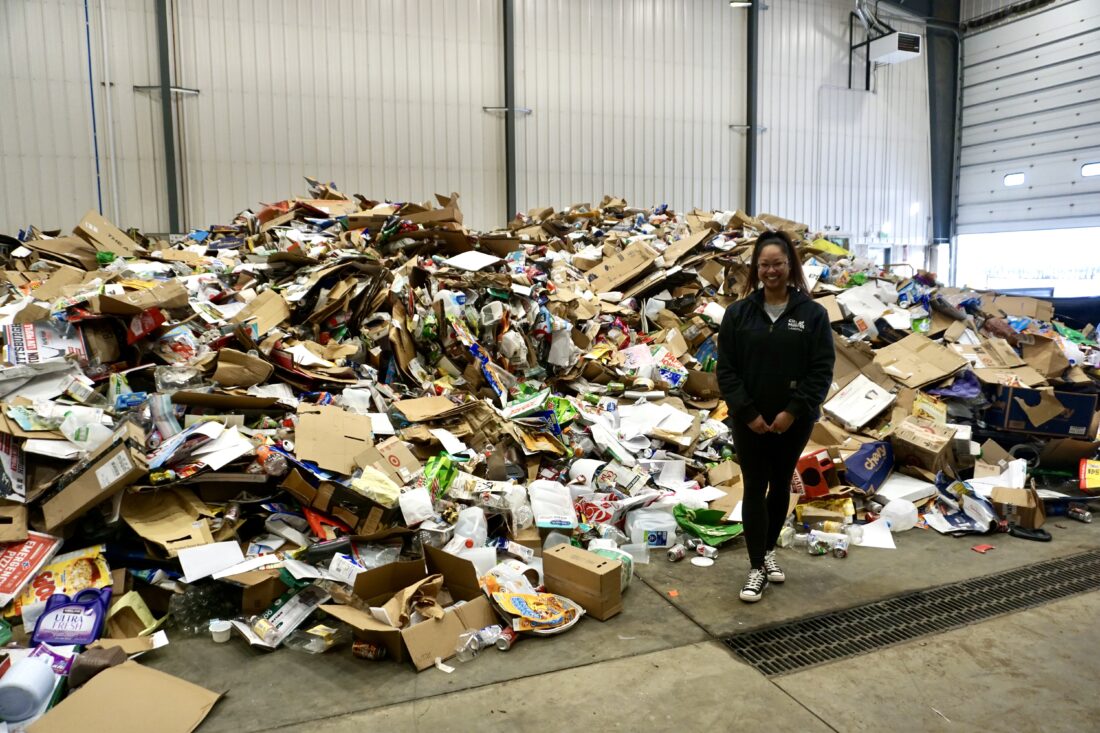
Minot recycling coordinator Christina Wolf stands next to about a 17-ton stack of recyclables from a December collection day in the transfer facility at the Minot City Landfill Dec. 15. The recyclables will be compressed and loaded for transport to a Shakopee, Minn., processing facility.
A new curbside recycling program that has been dotting Minot neighborhoods with blue-lidded containers on collection days has saved 467.16 tons of material from landfill disposal between its launch in July and the end of November, according to City of Minot data.
Recycling coordinator Christina Wolf said monthly tonnage has been increasing as residents have gained experience with the program. The participation rate is about 80%. The opportunity to opt out ended in October, which means any new residential customers must participate.
“It’s actually gone a lot better than we anticipated. And we hope to continue that,” Wolf said.
One of the big concerns initially was that residents might place high levels of contaminants in their recycling. Items considered contaminants include improperly rinsed food containers or nonrecyclable materials.
Wolf said the contamination rate within Minot collections has been 17%, although some materials would have been acceptable had they not become wet from the weather. Had the weather not played a role, the contamination rate would have been around 10%, she said.
“The national average would be about 20 to 30 percent contamination,” she said. “The company that did our capture rate said that they were actually surprised and were very happy with the way we are going about the recycling.”
The biggest contaminants have been plastic bags and styrofoam. However, Christmas lights, clothing, a sled, hoses and wiring, insulin needles, oily pizza boxes, hangers and books, and even a knife and dead cat, have been among contaminants found in Minot’s recyclable collections.
Minot’s curbside program also does not take glass because the weight makes it cost prohibitive to ship to a processing facility.
Part of Wolf’s job entails checking through collected recycling to remove contaminants. Another part is continuous education with residents about what can be recycled. Christmas brought a new need for education, given the different types of garbage the holidays generate.
Wolf also has provided education in schools about recycling and ways to reuse items.
The city offers residential recycling pickup every other week. Collected recyclables are deposited in a newly built transfer facility at the landfill, where they are pushed along a conveyer into a compactor before being loaded into a trailer backed up to the facility. The city owns two trailers, which when filled are hauled by a contractor to a processing facility in Shakopee, Minnesota.
The city receives an 80% rebate based on market value and tonnage of the materials.
“Right now the commodity prices are in our favor. So we are making some money, but we also have to pay our tipping fees when we bring it there,” Wolf said.
For instance, in November, the city paid about $2,800 in tipping fees but received a $4,000 rebate, she said. The money goes back into the city’s recycling program for future support. Currently, a grant and the $2.50 monthly recycling fee paid by participating residents covers the costs.
Wolf said the recycling program is at capacity and eventually may need to acquire a third trailer. The goal is to expand the program and encourage participation by private sanitation haulers who pick up from apartments, businesses or other communities and utilize Minot’s landfill, she said.
In the meantime, the recycling program accepts recyclables from individuals at its landfill scale house. The cost is $175 a ton, with a minimum charge of $3.
“I think the most anyone has paid is like $15, but they’ve literally had a truckload,” Wolf said. She estimated the program gets a handful of individual recyclers a month.
Recycled plastic may end up as signage, clothing, garden supplies or lumber for creating furniture. Beverage companies often buy back aluminum to repurpose them in cans. Metals can be recast into new products. Paper and cardboard typically go to paper mills to create more paper products.
Wolf said the curbside program gets positive feedback from community members who have waited a long time for this type of recycling opportunity.
“They like the program. They’re excited,” she said, noting that some have embraced the program by adding second recycling containers.
Local News
Funds available to improve maternal health in ND
FARGO – Organizations supporting maternal health care in North Dakota are invited to apply for a Maternal Health ...

Western Plains Opera, MSU Theatre to present ‘Chicago’
Parenting book study begins April 8
A free book study on “Raising Good Humans” will be held online on Tuesdays from April 8 through May 6 at 6:30 ...
Local event benefits military members at Minot AFB
Minot Symphony Orchestra to present ‘Pirates of the Caribbean’
The Minot Symphony Orchestra will present Disney’s "Pirates of the Caribbean: The Curse of the Black Pearl" in ...
Maple sugaring event on tap at Fort Stevenson
GARRISON – Fort Stevenson State Park will host Maple Sugaring Days for some sweet days of learning and fun as ...