Public leaders share lessons learned
Symposium encourages women to be leaders
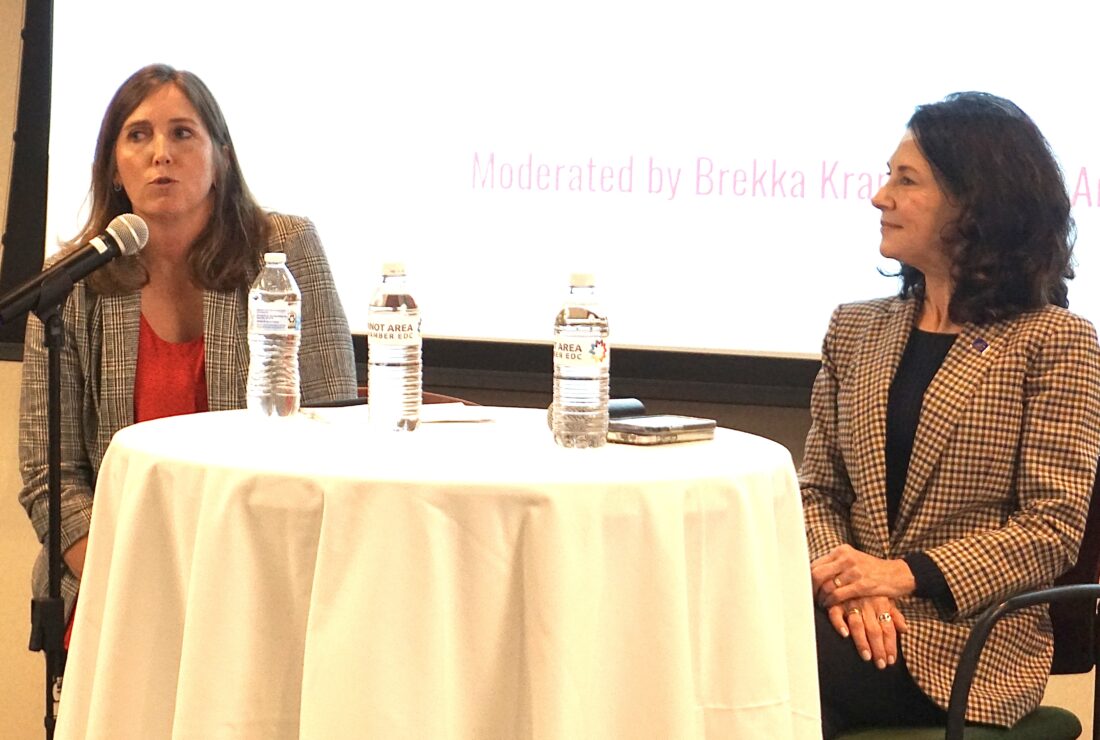
Jill Schramm/MDN Andrea Travnicek, left, director of the N.D. Department of Water Resources, and Lt. Gov. Tammy Miller take part on a panel at the Women in Public Leadership Symposium hosted by Minot Area Chamber EDC at Minot State University Tuesday.
Gaining a voice in the public arena starts with listening and asking questions, according to five women in government leadership who spoke at a symposium in Minot Tuesday.
Lt. Gov. Tammy Miller and Andrea Travnicek, director of the North Dakota Department of Water Resources, spoke on a panel regarding their path to leadership, while Public Service Commissioner Julie Fedorchak, state Rep. Emily O’Brien of Grand Forks and Sen. Karen Krebsbach of Minot shared advice on a second panel at the Women in Public Leadership Symposium hosted by Minot Area Chamber EDC at Minot State University.
“You need to have your voice heard and you need to make a difference,” Miller told the audience.
Travnicek urged the audience to not just to speak but to listen, too.
“I know that I’ve done a lot of also being quiet and listening and stepping back because there’s a lot still that I have to learn and there’s a lot that I have learned from others,” she said.
Travnicek also urged listeners to not be afraid to grasp opportunities.
“I’ve just been fortunate to feel empowered every day and work through some really important, complicated issues on all different fronts,” she said.
“Don’t wait for someone to ask you or tell you what to do,” Miller added. “Be the kind of girl that just goes for it and do what needs to be done.”
Miller and Travnicek spoke about the importance that male and female mentors had in their careers and their desire to mentor others.
“Many, many people ask if I will be their mentor, and I say yes to every single person who asks, but all of the responsibility is on them. They have to schedule all of the meetings. They need to commit to bring an agenda to every meeting, and they need to commit to following up on their commitments,” Miller said. “My purpose in life, especially now, is really to help others reach their full potential.”
O’Brien was elected to the House at age 24, knowing little about the political process. Seven years later, she now chairs the House Appropriations Committee’s Human Resources Division. Working with the state’s largest budget area, she said, she spent from 6 a.m. to 2 a.m. at the Capitol, educating herself.
“I think the best advice that I was given was that not everybody loves you, and you have two ears and one mouth,” she said.
Fedorchak also said she knew little about the Public Service Commission when first appointed in December 2012.
“I had to spend two to three years just really asking questions and listening,” she said. “Everybody knows you’re new. So they kind of know that you don’t know that much. So it’s better to sit back and ask questions and listen and kind of admit it and not act like you do know everything.”
Krebsbach, who has served in the state Senate since 1989, said many opportunities came to her just because people wanted a woman to fill a minority slot on a board.
“They found out I had a voice and I used my voice. Most of the time, I used my voice to learn. I asked questions,” she said. Eating up every bit of knowledge that came her way, she said, it led to her becoming the state’s first female president of the Greater North Dakota Association, the state’s chamber of commerce.
The women also spoke about being under-estimated as women in leadership roles.
Miller spoke about being mistaken at an out-of-state conference for her company president’s secretary rather than the company’s vice president of finance. O’Brien recalls being mistaken for a legislative intern by a fellow senator and for the granddaughter of another senator by a company CEO at an industry awards ceremony. While all were embarrassed and apologetic when realizing their errors, O’Brien noted, “It was just an interesting perspective on where people think that the stereotype is and who should be involved and why they should be involved.”
Knowing where and when to get involved was stressed as well. Miller reminded prospective leaders that it is OK to say no because no one can do it all.
“Figure out what your priorities are. Make those good choices,” she said.
“Find a way to connect your passion with that service. It might be political. It might not,” she added. “Those volunteer opportunities will give you great skills, will help you learn a lot about the community and will also connect you to a great network.”
Local News
Park district announces 2026 Movies in the Park
The Minot Park District has announced the return of its popular Movies in the Park series for summer 2026. Movies ...
County faces digital accessibility deadline
Ward County is working under a time crunch to comply with new federal rule regarding access to a government’s ...
Minot VFW Post donates Teddy bears
Suspect arrested in theft investigation
The Minot Police Department’s investigations into a stolen credit card and vehicle this week received a break on ...
Minot High adopts new secondary logo
Minot High School has officially adopted a new secondary logo amid an ongoing trademark dispute with the University ...