
Park tree removal planned
Trending
About 450 trees will be felled in Minot's Roosevelt Park to make way for the start of construction next spring on another phase of the flood protection project.
Ryan Ackerman, administrator for the Souris River Joint Board, said about 350 of the trees must be removed for flood control features and another 100 trees are in the way of the planned reconfiguration of Roosevelt Park and Zoo.
The tree removal will mark the start of three years of flood project construction in the area, but the disruption will be worth it, according to Elly DesLauriers, executive director of Minot Parks.
"We know at the end of all this, Roosevelt Park is going to look very different. But, if we look to the future and the positive, I think it’s going to look really good. I think we’ll have a lot of functionality, and the end goal is going to be beautiful," DesLauriers said.
She said the park district has been working with the joint board on flood control plans since flood waters receded in 2011.
"As we get closer to this all becoming reality, there’s something to be said for a plan moving from paper to actually marking trees in the park, and with that, it becomes very, very real," she said. "We know there’s going to be a lot of emotions that come with it. It’s emotions for our community. It's emotions for the park district, and I dare say it’s emotions for the people actually out there surveying and mapping out this plan because these are people who live, work and play here."
The park board recently performed a walk-through of the park, where pink ribbons designate trees to be removed. If trees can be saved, they will be, DesLauriers said.
"We want our community to know that we’re taking everything into account as we go through this. But I think the end goal of all this is that our community is safe, our individual citizens' homes are safe, our facilities are safe," she said.
The trees to be removed are of various sizes, including some nearly 100 years old and cottonwoods more than 100 feet tall. However, given their ages and the damage from the 2011 flood, some of the trees aren't in good shape.
The removal is scheduled for winter to avoid disruption to the habitat of the northern long-eared bat, a threatened and endangered species, during the late spring and early summer when the tree-dwelling bats would be in the area.
The disposal of the wood will depend on the removal contract, but the general practice is to convert it to mulch, Ackerman said.
The construction project to be bid this winter will feature flood wall from the northern entrance into Roosevelt Park, near the pool, to the bathhouses, where an earthen levee begins. The levee will continue along the river until it transitions back to floodwall in the vicinity of the pickleball courts. From there, floodwall will extend south and through the zoo before terminating at Burdick Expressway. The construction will be limited to the west side of Roosevelt Park because the east side is part of a separate phase of the Mouse River Enhanced Flood Protection Project.
Construction disruptions will be felt most heavily next year in the park portion of the project. DesLauriers said the park district will be pushing out information to the public starting next spring to make them aware of different park access points that will be in place.
She said safety has been the main consideration in determining which activities will remain and which will be suspended. Rental of front-lawn facilities on the west side will be curtailed, although the eastern half of the park, which includes the amphitheater and picnic shelters, will remain in use. DesLauriers said an alternative location is being sought for the annual Festival in the Park on July 4.
The pickleball courts and pool will not be directly impacted and are expected to remain open during construction. Playgrounds, restrooms and picnic shelters will be relocated as necessary during construction to remain open for the public.
The Magic CIty Express, the mini-train that runs through the park, will be out of service for three years during the construction that is scheduled to finish in 2026.
"Ultimately, they’ll be able to come back and have a slightly different route that I think is going to be a lot more engaging, including being able to go through a portion of the zoo," Ackerman said.
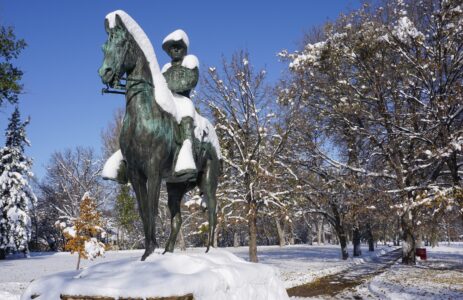
The zoo's North American exhibit will be relocated from the north side of the river to the dry side of the floodwall, in the vicinity of the Roosevelt statue, which will move to a new prominent location not yet identified.
Within the zoo, there will be some changes, such as relocation of a concession stand and impacts to some exhibits, but the zoo is expected to remain open. The heaviest construction impact on the zoo is anticipated in 2025-26.
The side of the river being vacated by the zoo will become an extension of the eastern portion of Roosevelt Park. The final result will be a park that is much the same size as currently exists, Ackerman said.
"The uses and the types of features that are there will be similar. However, there will be a levee through the middle of much of this that still has some beneficial uses for trails, for sledding," he said. "There’s also the potential to discuss an expansion of Roosevelt Park to the north and west, across the river in the neighborhood that was acquired through the use of Community Development Block Grant dollars."
The buyout dollars bring restrictions on development, but the park district also owns property in that area that is not restricted beyond regular floodplain zoning, he said.
DesLauriers said the park board hasn't discussed park expansion in depth and isn't likely to make decisions until the upcoming MI-7 flood protection phase is completed.
Additionally, to comply with mitigation requirements and show a commitment to the park district, the flood project calls for planting two trees for every one removed, or about 900 trees. It will take time for those trees to grow and the landscape to mature, though.
"If you look at it from a generational perspective, 20 years from now I think the next generation is really going to appreciate what's been done today," Ackerman said. "It just requires patience on behalf of those of us that are living it today."