Human relations committee forges ahead despite challenges
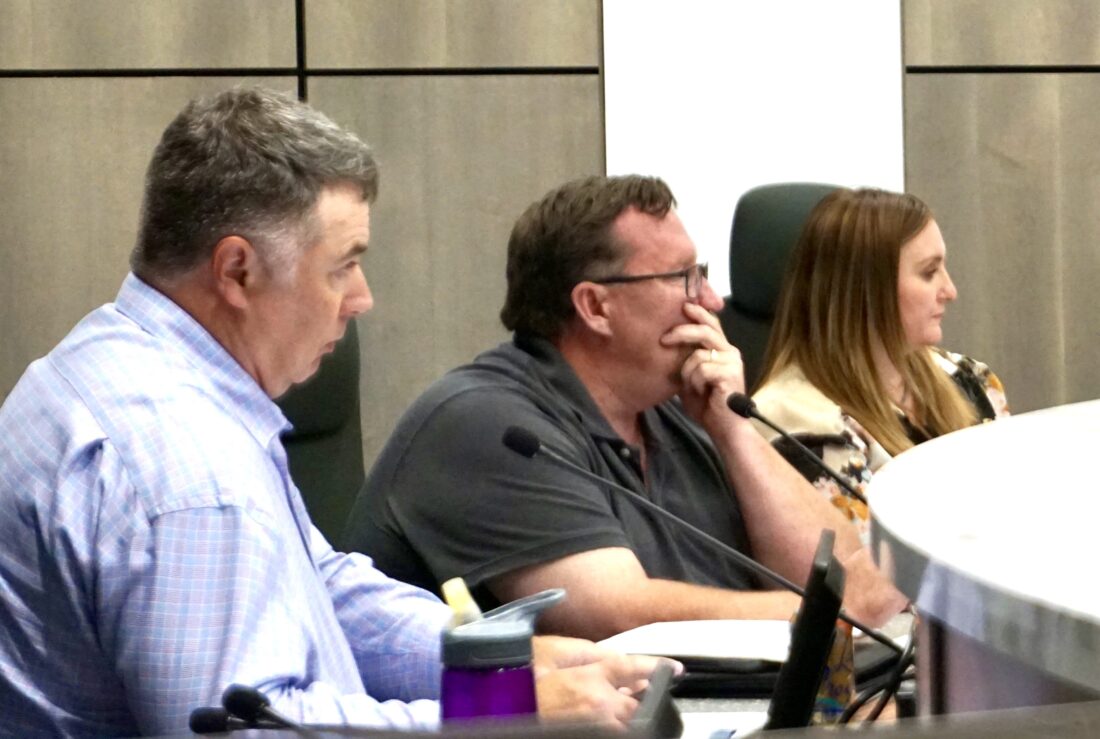
Jill Schramm/MDN Mike Blessum, Co-Chair Scott Burlingame and City Attorney Stefanie Stalheim take part in discussion at the first meeting of Minot’s new human relations committee Tuesday.
Minot’s human relations committee will be forging ahead after setting aside one member’s challenge to the legitimacy of the committee and suggestion that the ordinance creating the committee be repealed.
One of the first items of business when the committee, which met Tuesday, convenes again will be determining whether the city ordinance should establish a human rights commission that can make findings on grievances or a human relations committee with the objective of creating a safe space for dialogue. It also could discuss, as member Mike Blessum urged, whether to recommend the council repeal the ordinance and end the committee’s work.
“My preference would be that this not exist in ordinance. This is not the role of city government.,” Blessum said, stating that there would be recourse under any anti-discrimination model for someone who doesn’t meet the city’s standard. “I don’t think that this is the path overall that we should be heading down.”
Committee member Miranda Schuler said the council is unlikely to accept a recommendation to eliminate the ordinance.
“If that was what they wanted to do originally, they might have done that rather than getting us all together and wasting everyone’s time,” she said. “If we try to send it back to them, they’ll just send it back to us.”
“In my opinion,” Blessum added, “the council didn’t do its job to take care of this question. They forced it on a group of citizens to do it instead.”
The committee did not review any part of the ordinance on Tuesday. It did set out a plan of action and determined an agenda for its next meeting that includes discussing the name or type of committee, the objectives and officer job descriptions.
Current ordinance language lists objectives as:
– To act as a sounding board for the identification and resolution of community human relations problems.
– To identify and eliminate minor irritants before they develop into major problems.
– To evaluate discriminatory conditions and practices and make recommendations to the civilian and/or military authority concerning these problem areas.
Blessum questioned whether the nine-member committee appointed by individual council members is in compliance with the existing ordinance, which calls for up to 20 members appointed by the mayor, with the members selecting their officers each August. The council had dispensed with existing ordinance language in naming two co-chairs, giving them the right to vote and eliminating the ability of members to appoint their own alternates.
“It’s important that we follow the law. It’s important that we actually go by the rules that were laid out, even if they were written in the ’70s,” Blessum said. “I just think that we want to make sure that we do this the right way because of the contentious nature of what we’ve already been through.”
“I think we are kind of splitting hairs,” Co-Chair Lisa Olson responded. “We’ve been given a task. I think we can accomplish that task.”
The vote on Blessum’s motion to cease committee work until the council brings the committee’s organization in line with the existing ordinance brought some confusion because two committee members, Denise Dykeman and Christine Staley, were having technical difficulties in participating remotely. Ultimately, the motion failed 4-5.
The existing ordinance is expected to have a handful of sections that will be controversial and result in a more lengthy discussion. One is the grievance procedure. The ordinance states that any individual, group or organization may submit a grievance to any Human Relations Committee (HRC) officer or member for discussion, and a grievance investigative committee would be appointed to examine the grievance. The HRC would determine a plan for solution and would follow up after six months to ensure there has been resolution.
Minot City Manager Harold Stewart said since the 1970s, cities have generally turned grievance matters over the state while continuing to operate under a human relations committee model, which is the model favored by the council.
Local News
Felon charged after multi-agency investigation
A Minot man has been arrested and charged five felony counts for possession with intent to distribute marijauna and ...
Brine spill occurs near Killdeer
KILLDEER — A brine spill occurred at the Cougar 1 SWD site, about 20 miles northwest of Killdeer, Tuesday, March ...
Minot Municipal Court Dispositions
March 31 Talon Blake Hoaglund, 19, Minot, DUI/APC-first offense (Class B misdemeanor), chemical dependency ...
Air & Space Forces Association leader to speak at Minot AFB event
North Central District Court Dispositions
Mountrail County March 30 David Thomas Dwitz, 37, Tolley, DUI-0.16% or greater-first offense (Class B ...