
Flutter Fest event celebrates monarchs, other pollinators
More than 150 butterflies released
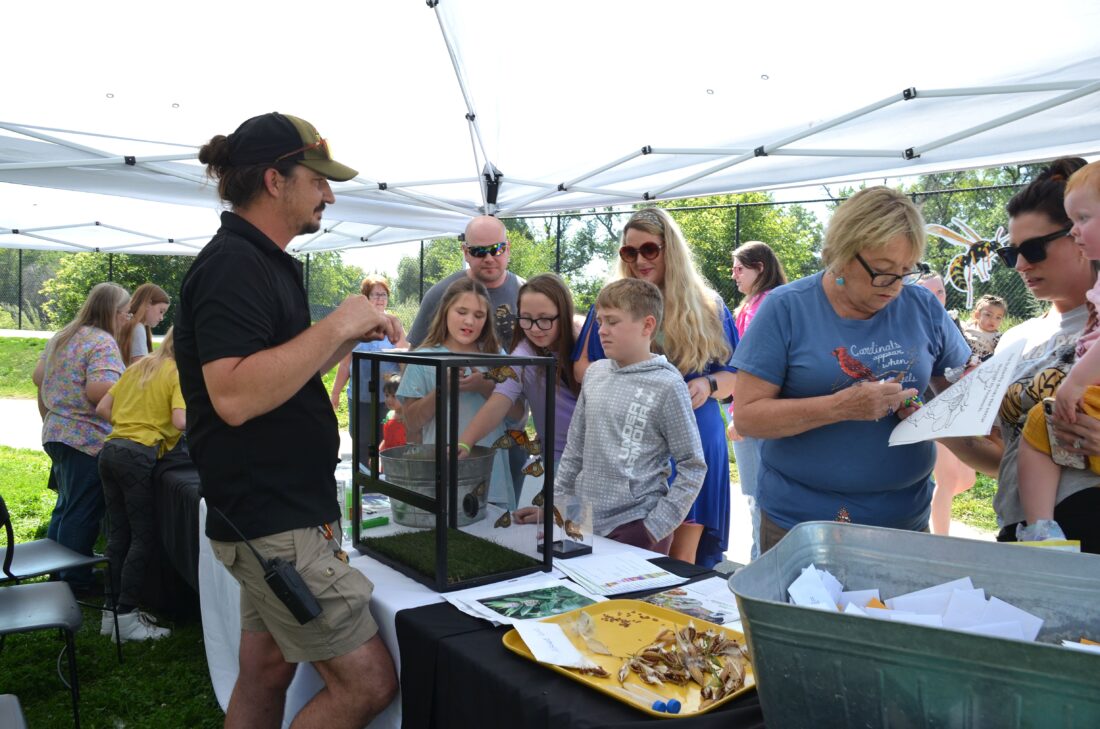
Eloise Ogden/MDN Dr. Logan Wood, veterinarian at Roosevelt Park Zoo in Minot, talks to zoo visitors about monarch butterflies at a booth during Flutter Fest held on Sunday.

Eloise Ogden/MDN Representatives of The Learning Tree daycare get ready to release 152 tagged monarch butterflies at Flutter Fest held at Roosevelt Park Zoo, Minot, on Sunday.

Dr. Logan Wood, veterinarian at Minot's Roosevelt Park Zoo, tells zoo visitors about monarch butterflies before 152 of the monarchs are released at Flutter Fest on Sunday.
Eloise Ogden/MDN Dr. Logan Wood, veterinarian at Roosevelt Park Zoo in Minot, talks to zoo visitors about monarch butterflies at a booth during Flutter Fest held on Sunday.
Eloise Ogden/MDN Representatives of The Learning Tree daycare get ready to release 152 tagged monarch butterflies at Flutter Fest held at Roosevelt Park Zoo, Minot, on Sunday.
Dr. Logan Wood, veterinarian at Minot's Roosevelt Park Zoo, tells zoo visitors about monarch butterflies before 152 of the monarchs are released at Flutter Fest on Sunday.
Trending
A total of 152 monarch butterflies fluttered from the pollinator garden at Minot's Roosevelt Park Zoo on Sunday following their release led by zoo veterinarian Dr. Logan Wood with the help of The Learning Tree daycare representatives.
The release was part of the zoo's Flutter Fest, an event sponsored by The Learning Tree, culminating with the release of the monarch butterflies. The Learning Tree representatives helping with the release included Kevin, Susan, Ellie and Kaden Cross, Emma Bedacht and Carole Rhodes.
The zoo held its first Flutter Fest in 2019 with about 50 monarch butterflies released.
In December 2019, Wood said, the Association of Zoos and Aquariums (AZA) announced it wanted to save the monarchs from extinction with a program to promote conservation of the species. In 2020, the zoo did not hold a Flutter Fest due to the COVID-19 pandemic. In 2021, the event was held again with the release of about 100 monarchs. Flutter Fest was not held in 2022 when the monarch population was down.
In the past two years, Wood said, locating and finding monarch caterpillars in Minot and the surrounding areas has been quite difficult.
"The reduced numbers of butterflies are likely due to several factors, including loss of habitat, increased pesticide use and climate change. Historical data suggests North Dakota, specifically, was once 85% prairie. Current data suggests we're closer to around 24%. This isn't only impacting the monarch butterflies but also our other native pollinators and animal species such as the western meadowlark," Wood said.
The monarchs released at the zoo on Sunday were purchased from an out-of-state butterfly farm due to the lack of these butterflies in the local area.
Since Flutter Fest started at the zoo in 2019, the zoo, with the help of the Minot Park District, has been able to help conserve and protect more than 190 acres (more than 8 million square feet) of monarch/pollinator habitat, Wood said. He said this includes seven registered Monarch Watch locations and 12 park properties with more than 35,000 pollinator-friendly plants planted each year. He said the largest property is the Bison Trail, east of Minot.
Besides the Bison Trail, the six other Monarch Watch locations that the Minot Park District manages are Leach Park, Roosevelt Park, the zoo, Oak Park, Nubbin Park and Woodland Trail.
Wood said each of the Monarch Watch sites has milkweed. Monarch caterpillars feed exclusively on the leaves of milkweed, the only host plant for the butterfly species.
He said most of the Monarch Watch sites have the two different common species of milkweed found in North Dakota - large common milkweed and the swamp milkweed, a smaller plant.
He said other pollinator-friendly plants are nectar-rich plants, including the coneflowers and black-eyed Susans. The butterfly plant is another pollinator-friendly plant.
Wood said sunflowers are pollinator-friendly and attract not only butterflies but bumble bees and honey bees.
"North Dakota is the No. 1 honey-producing state," he added.
"The goal is to promote pollinators by having people plant either some nectar-rich plants for pollinators or by not spraying or pulling up the milkweed. It's not a weed even though 'weed' is in the name," he said.
Not using pesticides is recommended "because pesticides can't differentiate the bad bugs that we don't like, like aphids, from the good ones like honeybees or butterflies," Wood said.
He said it's not just the insects that are pollinators but there's also animals.
During the Flutter Fest, animal chats and various other activities were held including a black-and-white ruffed lemur chat.
"That's the world's largest pollinator," Wood said. "He pretty much sticks his nose in flowers and will pollinate all the different flowers." He said bats and hummingbirds are also big pollinators.
U.S. Fish and Wildlife representatives were on hand on Sunday to talk about that agency's work in promoting conservation of pollinators and overall conservation. Lowe's Garden Center, the zoo and Master Gardeners also provided information to the zoo guests.
Overall, the event was an opportunity to get children and adults excited about pollinators, Wood said.
"It's not only about promoting and conserving the species, but this is a wild phenomenon that actually happens in our own backyard," Wood added. He said the monarchs "migrate 2,800-3,000 miles from Canada to Mexico and back. That's something not everybody gets to experience and what I'm trying to promote here."