
Dakota Datebook: July 10-14
White Cloud’s birthday
By MERRY HELM
July 10 – According to a Native American legend, a traveling war party once came upon a very large herd of buffalo spread throughout a wide valley, and right in their midst was a peaceful and beautiful buffalo of pure white. The war party saw that the other animals kept their distance, which was interpreted as a sign of great respect – the white buffalo was something very special and has remained so ever since.
Which brings us to White Cloud, a female albino that was born on this date in 1996 on Daniel and Jean Shirek’s farm north of Michigan, North Dakota. Their grandson first noticed her in the pasture but thought she was a large white rock. Daughter Francis said that the other buffalo huddled around White Cloud at first, as if they knew how rare she was; the chances of a buffalo being born albino are said to be about one in a billion. It was therefore a huge surprise when another albino – this one a male – was born on May 5, 2003, at the Big Sky Buffalo Ranch near Granville.
White Cloud died of old age in 2016.
Clement Lounsberry
By MERRY HELM
July 11 — Clement A. Lounsberry was born in 1843 in DeKalb County, Indiana. Like many people who gained notable success as adults, Lounsberry overcame great hardships during his youth, including being orphaned.
Lounsberry was working as a farm laborer when the Civil War broke out, and he soon enlisted with the First Michigan Volunteers. He was wounded and taken prisoner at the First Battle of Bull Run in July 1861. After spending a year in the hands of the enemy, he became part of a prisoner exchange and was released in June 1862.
Lounsberry promptly received an officer’s commission and was sent back into battle; over the next few years, he sustained three more injuries. He was a colonel in command of the First Michigan Sharpshooters and the Second Michigan Infantry regiments when he accepted the enemy’s surrender of Petersburg, Va.
After the war, Lounsberry moved to Martin County, Minn., where he began publishing the Martin County Atlas, but he made the decision to move farther west wherever and whenever the Northern Pacific constructed a line that crossed the Missouri River.
Meanwhile, he joined the Minneapolis Tribune as a legislative reporter and editorial writer. Finally, it came time for his move west, and on this date in 1873, his first copy of the newspaper in Bismarck rolled off the press.
Some say Mark Kellogg received the second copy; Kellogg was an early contributor who wrote under the penname Frontier. Lounsberry couldn’t afford to hire him full time – he called Kellogg his attache. Truth be told, Kellogg is believed to have edited the 2nd, 3rd and 4th issues of the paper, because Lounsberry was absent a great deal that first year. Plagued with financial problems, he was still working as a legislative reporter for the Minneapolis Tribune, and he was also handicapped with a painful limp from the last wound he suffered during the war. This condition was so problematic his leg ultimately had to be broken and reset.
The N.D. newspaper reached an early zenith when Lounsberry became the first newsman to report on the death of Custer and 268 cavalrymen at the Little Bighorn. Lounsberry couldn’t accompany Custer on that occasion, so he asked Mark Kellogg to go. It was the last time Kellogg and Lounsberry would ever see each other.
Lounsberry was a staunch Republican, and when he sold the Tribune in 1884, he was hoping he’d be appointed governor of Dakota Territory. Unfortunately, the position was awarded to a different newspaperman, Gilbert A. Pierce of the Chicago Daily News.
For the next 20 years, Lounsberry had a tough time sustaining success. During this period, he worked for a Land Office and published a historical monthly magazine in Fargo, an activity that led him to help organize the North Dakota Historical Society in the 1890s. Ultimately, his history magazines became the basis of his seminal creation, a huge three-volume book called North Dakota: History and People, which first appeared in January 1917.
In 1905, Lounsberry landed a job with the General Land Office in Washington, D. C., and despite his strong ties to N.D., he never came back. He died in October 1926 and is buried in Arlington National Cemetery.
Fanny Kelly, prisoner
By MERRY HELM
July 12 — On May 17, 1864, a party of six people began journeying from southeastern Kansas to the promising gold fields of Idaho. Among them was a young bachelor named Gardner Wakefield and the Kelly family, which included Josiah, his wife, Fanny, and Fanny’s young niece, Mary, whom the couple had adopted. Also with them were two black servants, Andy and Franklin.
A Methodist preacher joined them few days later, and a few weeks after that, William Larimer, his wife Sarah and their young son joined the train, which now had five wagons. Also joining them was Noah Taylor, who left his wife and eight children behind on their homestead.
The little group was both part of the problem and part of an approaching tragedy. It was a time of great anger and frustration among the Plains Indians. As a result of the Minnesota Uprising two years earlier, Generals Alfred Sully and Henry Sibley had been searching northern Dakota to punish some Santees who had revolted and killed hundreds of white settlers in Minnesota. With revenge fueling both sides, violence had been spiraling out of control. In fact, Sully’s retaliatory attack on hundreds of mostly Yanktonais – not Santees – at Whitestone Hill had taken place less than nine months before the Kellys began their overland journey.
There was another issue, as well. With gold having been found in several western regions, whites were encroaching more and more on land set aside for plains tribes under the Laramie Treaty. As the situation became more threatening to the Indians, skirmishes and raids on wagon trains escalated – especially if the groups were small, like the one in which Fanny Kelly was traveling.
Fanny was no stranger to hardship. Her father died while he was moving the family from Ontario to Kansas; in accordance with his wishes, the family finished the journey without him. Eleven-year-old Fanny, her widowed mother and her siblings had settled in Geneva, Kansas, where they learned to cope with the harsh conditions of homesteading.
Fanny’s current move to Idaho had a much different tone – more like an adventurous vacation. “The hours of noon and evening rest,” she wrote, “were spent in preparing our frugal meals, gathering flowers with our children, picking berries, hunting curiosities, or gazing in rapt wonder and admiration at the beauties of this strange, bewildering country.”
After several weeks, the little wagon train had made it across Nebraska to southeastern Wyoming. They had foregone opportunities to join larger wagon trains, because they could make better time traveling by themselves. Not that they hadn’t considered the danger – Fanny wrote, “…at Fort Laramie, where information that should have been reliable was given us, we had renewed assurances of the safety of the road and friendliness of the Indians. At Horseshoe Creek, which we had just left, and where there was a telegraph station, our inquiries had elicited similar assurances…”
It was at sunset, on this date in 1864, that everything changed for Fanny and her 10 companions. Suddenly, Fanny wrote, “the bluffs before us were covered with a party of about two hundred and fifty Indians, painted and equipped for war…” The group allowed the war party to take whatever they wanted, but the situation soon fell apart. Five men were killed, two escaped, and Fanny, Sarah Larimer and their two children were taken prisoner.
The Kelly-Larimer party didn’t know that news had reached the Hunkpapas. Two weeks earlier, it’s alleged that one of General Sully’s men was killed by three Indians, who then fled. Sully’s men chased them down, then decapitated them and mounted their heads on poles near their camp. This atrocity just further ignited hatred toward whites.
Fanny Kelly was to witness Sully clash with the Sioux again at Killdeer Mountain. She would also be the guest of Sitting Bull and his wife – but these are stories for another day.
Elephants
By SARAH WALKER
July 13 — Elephants have long been used in a variety of ways, from Hannibal employing them during the Second Punic War, to providing the model for the main character of the children’s book “Babar,” or symbolizing the Republican Party. However, especially in western culture, elephants are perhaps best known for their roles in zoos and circuses.
So there was some excitement that for three days in 1951, a trio of elephants would perform in a traveling circus in Fargo. In fact, these elephants had already attained some fame — they were movie stars! The animals had been used for about seven years in movies produced by MGM studios, appearing mostly in Tarzan pictures. But in 1946, the studio abandoned Tarzan movies and the elephants were almost out of a job — so Frank Whitbeck, a studio official at MGM, bought them.
In 1947, Whitbeck, along with two wild animal trainers, incorporated a business called “Elephants, Inc,” the first corporation ever formed in the U.S. to deal exclusively with elephants, with a purpose of buying, selling, training and leasing elephants. The three elephants, better known as Sally, Queenie and Happy, the “Three girls from Hollywood,” were listed as assets, and they were already traveling the Midwest as part of the Polack Brothers’ Circus.
This movie-star history may have made the elephants even more exciting to the youth expecting to go. Especially so for a faction in Fargo. For on this date, the Fargo businessmen and the El Zagal Shrine temple hosted 150 newspaper carriers and salesmen at the matinee performance.
Of course, the conditions elephants live and work in have been a point of much contention over the years. But it is noteworthy that the Polack Brothers’ elephant trainer, James (Slivers) and his wife Jo Madison said, “As most humans respect authority, so does an elephant.” He also said he didn’t use bull hooks on the elephants, asserting: “It is cruel and unnecessary. Neither is it necessary to yell at them. I’ve learned that if you speak quietly and firmly and merely use a leather thong to cue them, you get quicker results and more respect from them.”
One must suppose that nobody carried water for the Three girls from Hollywood, though, as just one adult elephant can drink approximately 60 gallons of water a day. It would be easier to bring the elephant to the water!
New Town
By SARAH WALKER
July 14 — The people of New Town knew how to make the best out of a situation. They formed the city by combining the forces of Sanish, Van Hook and Elbowoods, after it was learned that the Garrison Dam project would flood those communities. By 1953, New Town was populated and development continued.
The people thrived in their new city with a variety of business and enterprise. And on this date in 1956, amidst great pomp and circumstance, Robert Box’s new business in New Town, the Dakota Boat Factory, was dedicated. He was set up in a three-story building – the old Snyder Hotel that had been moved from Sanish.
This factory was special for many reasons — and not just because it stood in the middle of the continent in a land-locked state. There was actually plenty of water around, especially with the Garrison Dam giving rise to Lake Sakakawea. Consequently, New Town was deemed a perfect place for a boat factory. In fact, it was the New Town Industrial Corporation that asked Box to establish his business in New Town, instead of Grand Rapids, Minnesota. He accepted, and with their assistance, set up shop.
Not only did the factory employ a handful of people, but Box said it could kick out a boat a day. The factory had been in operation for about a month before its dedication, and had already produced 25 boats, with round bottoms, and ranging from 14 to 18 feet in length. The boats were built from cedar strips fastened to white oak steam-bent ribs and were covered with leak-proof Fiberglas cloth.
Governor Brunsdale, who was at the dedication, welcomed new business, saying, “We can expect sizeable new enterprises to come in when we begin developing our natural resources.”
Those natural resources and the available manpower prompted Brunsdale to predict that “within the next ten years a lot fewer young people will be leaving the state; they’ll be working in North Dakota industries.”
Afterward, to top off the day, Box gave Governor Brunsdale and other officials a boat ride around the Four Bears Bridge.
“Dakota Datebook” is a radio series from Prairie Public in partnership with the State Historical Society of North Dakota and with funding from Humanities North Dakota.
Local News
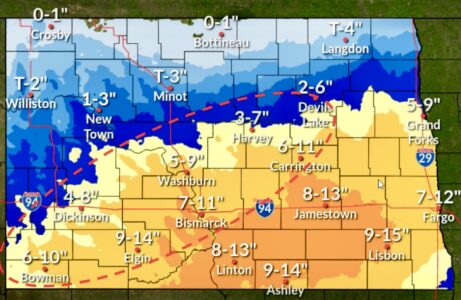
Minot to escape worst of snowstorm
Felon charged after multi-agency investigation
A Minot man has been arrested and charged five felony counts for possession with intent to distribute marijauna and ...
Brine spill occurs near Killdeer
KILLDEER — A brine spill occurred at the Cougar 1 SWD site, about 20 miles northwest of Killdeer, Tuesday, March ...
Minot Municipal Court Dispositions
March 31 Talon Blake Hoaglund, 19, Minot, DUI/APC-first offense (Class B misdemeanor), chemical dependency ...

Air & Space Forces Association leader to speak at Minot AFB event
North Central District Court Dispositions
Mountrail County March 30 David Thomas Dwitz, 37, Tolley, DUI-0.16% or greater-first offense (Class B ...