
Board updates public on river oversight
Trending
The international board that oversees river flow apportionment and flood operations on the Souris River has been reorganizing under a new 2022 directive.
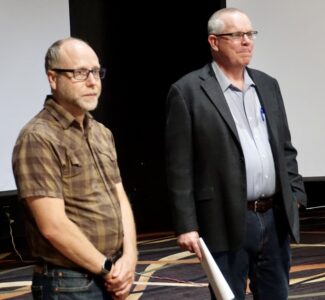
The International Souris River Board held a public information meeting in Minot Monday to talk about cross-border water matters and the changes related to its restructuring. The ISRB functions to assist the International Joint Commission in preventing and resolving disputes relating to transboundary waters of the Souris River Basin.
"The International Joint Commission had some areas that they thought could be improved by reformatting the board a little bit. So we're in that phase. Whether those improvements will be realized, I think, time will tell," said board co-chairman Eric Volkman with the U.S. Geological Survey, Rapid City, South Dakota. "I think we would be in a better position to answer whether the improvements are real in a year."
The new directive, which replaces a 2007 directive, outlines the purpose of the board, which now is smaller with 14 members rather than about 20. Although the same agencies are represented, there will be new indigenous representation. The number of public members on the committee has been reduced from six to two, but a separate public advisory committee will play a greater role.
"We've made some pretty significant changes to the structure," said board co-chairman Bruce Davison, with Environment and Climate Change Canada, in Saskatoon, Saskatchewan. The committees and subcommittees, where the work starts, also are being revamped.
"It's very much meant to be a bottom-up sort of body. The problem is a lot of the committees and subcommittees have not yet been fully staffed," Volkman said. "We're still working through some of those issues to try to get all committees and subcommittees at least to the point where we can get some work done.
"Bruce and I are very invested in the idea that where we can get work done, we're going to get work done," he added. "We do have some successes that we are piggybacking from the previous board."
Among successes are improvements in the mechanics for the water apportionment calculations and the stream flow monitoring, although work is ongoing to increase the transparency in those areas, he said.
"We're looking at rightsizing some of the climate change work that we've done in the basin. We're going to continue to work to distribute the data on the website and try to make it more of a one-stop shop for people that are interested in the data. And again, Bruce and I are very dedicated to making sure that data is as transparent as possible," Volkman said.
Volkman and Davison also provided a recap of the past year's flood watch. Soil moisture going into the winter and snowpack over winter both were average to below normal. The ISRB forecasted an even split in water apportionment between Canada and the United States. However, the amount of flow across the border at Sherwood, with Lake Darling filling, triggered a change in which Canada would retain 60% of the water.
Water quality conditions at Sherwood and Westhope checkpoints still are being analyzed so information wasn't readily available at Monday's meeting. Volkman said 2023 water quality monitoring is back on track, though, after disruptions during the pandemic.