
State looks to get new childcare dollars into communities
Trending
A Minot committee will be looking to get the word out to parents and employers about new childcare assistance after hearing the specifics of the nearly $66 million approved by the Legislature this past session.
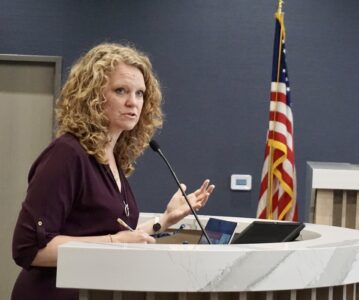
The legislation addresses affordability, availability and quality, said Jessica Thomasson, executive director of the Human Services Division in the North Dakota Department of Human Services, who spoke Thursday to a Minot committee tasked with investigating those issues locally.
"Unless you tackle all three of these things at the same time, and with equal vigor, you're not going to have the impact that you want to have," she said. "We have to do all these things at the same time and, hopefully, that creates a great platform for cities like Minot, and Ward County, and other communities to add your own flavor and your own lens to what that looks like. But the idea is for this to be a starting point."
Childcare often ranks with housing as a family's greatest expense, Thomasson said.
"If we can help working families think about how to make this more affordable, it's going to help our childcare businesses be able to charge what it actually costs them to provide the service, which makes it more available, which makes the quality more available," she said.
Key components of the state plan include changes to the existing childcare assistance program:
-- Invest $22 million into the program, expanding eligibility to about another 1,800 children a year.
-- Increase provider payments by about 40% for infant and toddler care, $15 million.
-- Eliminate the co-pay for about 2,200 families who are at 30% of median state income or less, $2.3 million.
-- Create quality tiers in the payment schedule and infrastructure to support excellence in service delivery, $6 million.
-- Invest $500,000 into improving customer experience with the program, including avoiding assistance denials to eligible applicants based on technicalities.
Thomasson said almost 50% of applicants get denied.
"Our goal is to get that percentage down. If you apply for childcare assistance and you are eligible, you shouldn't be denied because it was too hard to get through the process," Thomasson said.
She said the changes to the childcare assistance program will create greater opportunities for parents to find childcare because costs and co-pays will be less restricting. The state contributions also help providers by ensuring a more stable source of revenue so they can consider expansion, she said.
"We're trying to stabilize the revenue that ultimately is flowing through that business without dictating how you run your business, where you run it or what the size is, but to try to make the environment for operating more business friendly for the childcare business," she said. "It's a hard business to operate. We want to make it easier for you to be successful."
Other state investments include:
-- $8 million for the existing employer-led childcare cost-sharing program. Workers who receive employer assistance with childcare can receive matching funds from the state up to $300. The household income cannot be above 100% of the state median income, about $107,000 for a family of four.
-- $1 million to streamline childcare worker background checks and reduce administrative burden. It includes exemption from the state licensing process for providers already certified by the Department of Defense.
-- $7 million for provider grants, incentives and shared services such as contracting for a childcare operation's business administration services.
-- $1.8 million to create partnerships for care provided during nontraditional hours.
-- $2 million to reward workers for completing training beyond requirements.
Thomasson said the department hopes to have the changes ready for implementation once the appropriation becomes available July 1. The department wants to work with employers and childcare providers to get the information out to families.
"If I were in your seats, I would probably be thinking about 'how do you make sure that the people in your community, the families and the businesses in your community know what to do?' Because there are a lot of people who just are not aware that this is a resource," Thomasson told the committee.
Committee member Amy Jenkins, a childcare licensing specialist, cited the stigma that keeps families from applying for childcare assistance. She stressed the importance of eliminating stigma by focusing on the positive outcomes in using the aid.
"It's almost more like -- who can afford it?" Thomasson said of the need for families to consider assistance to ensure they can access quality care. "It's not about a failing. It's not about you as a family not being able to do something. It's just a reality. It's an economic reality of raising kids, and all of us benefit when quality care is available to all kids."