
Rural clinics deliver healthcare with personal touch
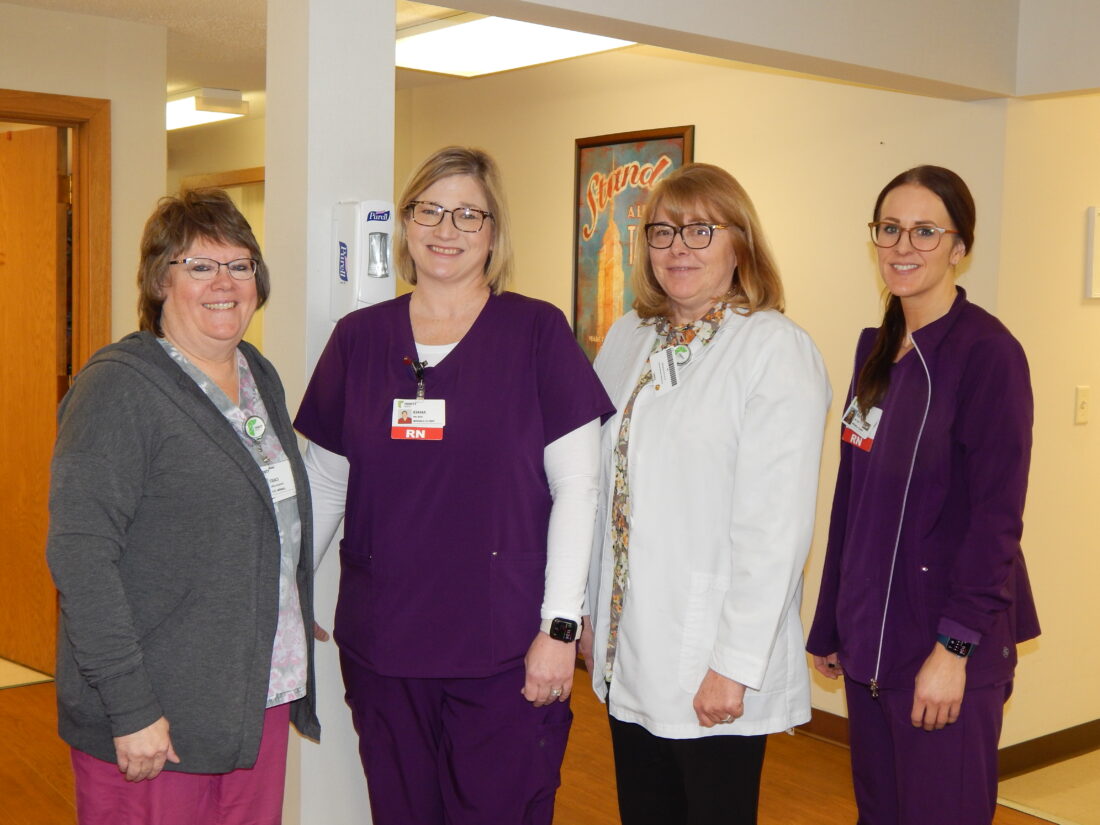
Submitted Photo Mohall clinic staff, from left, are Traci Johnson, Emma Glessing, Ruth Stanley and Kayla Kremer.
Rural communities are great places to live and raise a family. Yet studies show that people from rural parts of the country are more likely to die prematurely from the five leading causes of death in the U.S. – heart disease, cancer, trauma, respiratory illness and stroke.
The Centers for Disease Control and Prevention (CDC) cites several factors for why rural populations face a shorter life expectancy than their urban counterparts. They range from higher rates of smoking to patterns of seatbelt use. But lack of access to healthcare services is also a critical factor.
“Research tells us where there’s less access to healthcare services the result is poorer health outcomes,” noted Ruth Stanley, FNP-C, a rural health nurse practitioner who has dedicated her career to improving health outcomes for rural patients. “It just makes sense; if you don’t have access to a healthcare provider, it’s not going to bode well for your health. That’s why it’s so important to have that access to rural health clinics, where people can establish themselves with a primary care provider.”
Stanley, along with registered nurses Emma Glessing, RN, BSN, Kayla Kremer, RN, BSN, and administrative assistant Traci Johnson, comprise the care team at Trinity Health Mohall Clinic, one of eight rural health clinics that Trinity Health has sustained through the years as part of its commitment to supporting rural access to healthcare in North Dakota.
With close to 40 years of nursing and nurse practitioner experience, Stanley knows her way around a stethoscope. Moreover, she’s adept at doing her part to combat the lifestyle issues referenced by the CDC in its rural health report.
“We do a lot of education on self-care skills to prevent disease. But we try to connect with patients, so they don’t feel like we’re here to judge them,” she said.
A 1986 graduate of the former Trinity School of Nursing, Stanley joined the Mohall clinic as a staff nurse. She earned her Bachelor of Science in Nursing from the University of Phoenix and completed her Master of Science in Advanced Nursing Practice from Concordia University Wisconsin. She is certified by the American Academy of Nurse Practitioners.
According to Stanley, a typical day at the Mohall clinic can involve a broad range of health issues.
“It goes from A to Z really,” she said. “Typically, we do annual physicals. We do a lot of acute care which can vary from sore throats to chest pain and abdominal pain. It’s never routine.”
She adds, “My patients range in age from newborns to 100-year-olds.”
She says patients understand that for certain healthcare services they need to “go downtown,” which is clinic-speak for making the trip to Minot.
“They know I can’t do their colonoscopy, but I can get it scheduled and get the ball rolling,” she says.
Located at 504 1st St. SE in Mohall, Trinity Health Mohall Clinic provides convenient access to patients of all ages for a broad range of primary care services, including annual physicals, diagnosis and treatment of various illnesses, management of chronic conditions and arranging referrals to medical specialists. They also offer immunizations, x-ray and laboratory services.
“We do blood draws and can do a few point-of-care tests such as strep, pregnancy, influenza and COVID,” Stanley said. “For other tests, we process the blood and the courier picks it up and delivers it to Minot.”
While recruiting and retaining healthcare professionals to practice in rural communities remains challenging throughout the U.S., Stanley says she feels blessed.
“I’m lucky, I have staff who’ve worked here long term. Patients love it because they know the staff and feel comfortable coming here. It’s a less anxious environment and the patients feel more at home,” she said.
As an experienced nurse practitioner, Stanley would be a welcome addition in any healthcare setting, but she can’t imagine serving patients anywhere else.
“Rural health is my thing,” she said. “You get to know the people; you know their health problems. It’s a personal kind of care, and that’s what I love about rural health. Besides, I’ve had people tell me that if we weren’t here, they don’t know what they’d do; they might never see a healthcare provider.”
Local News
Research Center precipitation report
On Monday, March 30, at 8 a.m., 0.04-inch of moisture and 0.5-inch of snow was recorded at the North Central ...

Lewis and Clark Day planned at Confluence center
Area students advance to state science competition

Vietnam veterans day marks fellowship, healing
Minuteman III ICBM to be exhibited in new ND Military Gallery
City offices to close on Good Friday
City of Minot offices will be closed Friday, April 3, in observance of the Good Friday holiday. City transit buses ...