
Education alliance benefits region
Affiliation lets MSU, DCB do more in communities
Trending
Minot State University and Dakota College at Bottineau differ in their academic focuses, but their administrators say those differences make for a great partnership.
"I like to say that we get our strength through this collaboration," DCB Campus Dean Carmen Simone said of the 27-year affiliation of DCB with MSU. "It's just such a win-win for the institutions but also for the community."
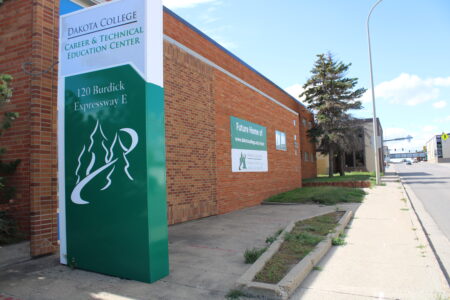
The new career and technical education center that the two schools are developing in downtown Minot demonstrates the advantage of their years of experience in cooperation.
"Because we collaborate already and we've learned how to do this over the last couple of decades, it just makes it all the more easy for us to work together to really meet the goals of the community, not to serve ourselves, but to serve the communities where we're located. I'm really proud of that work," Simone said.
"This is going to be a wonderful benefit for this community, for this region," MSU President Steve Shirley said of the new CTE. "The western half of North Dakota is going to benefit because of this. And again, it all I think really started with the relationship between MSU and DCB.
Historically, the college at Bottineau was once affiliated with North Dakota State University in Fargo as NDSU-Bottineau. In 1996, it became affiliated with Minot State as MSU-Bottineau and, in 2009, changed its name to Dakota College at Bottineau.
The North Dakota University System generally is transfer-friendly for students, but transfers are particularly seamless from DCB to MSU because of their relationship.
A former DCB Student Senate president and women's hockey team member, Adyson Jelleberg is in her first year at MSU. Choosing to spend her first two years close to home, Jelleberg knew she would go on to a four-year school to get an elementary education degree, but MSU wasn't initially among her top choices.
"After going to DCB and noting that being in a small atmosphere is something that I really liked - not having the big class sizes and things like that - I toured Minot State and I realized that it wasn't going to be too much different from DCB. The classes were small. The teachers knew you by name. You weren't just a number. You were a person, and that really stood out to me on my tour," she said.
Jelleberg overcame what remained of her timidity on the larger campus by joining MSU Life, the hub of student activities.
"That has been a huge part of helping me get back to being the outgoing person that I am. I think that every day Minot State is showing me more and more of how great it is and bringing me to be who I am and showing my true self more and more every day. The people that are here helped me to do that," she said.
In addition to streamlined transfer processes, the state's university system has created specialty areas where coursework is designed to be seamless among its institutions. Simone said the goal is to create a pathway from certification to community college to the university to enable students to build onto their education while working.
"The Dakota Nursing Program, for example, is very collaborative across the system. We have the same sort of setup at the two-year level of agriculture, where the institutions have experts on their campuses that help the other campuses, and it makes it possible for the smaller colleges to really survive and to be able to offer those kinds of programs," Simone said.
Much of what happens in the MSU-DCB collaboration, though, occurs behind the scenes, in the back offices that the public doesn't see but that can create significant efficiencies, according to Shirley. MSU lends resources to DCB in areas such as human resources, payroll, institutional research, Title IX, printing and technology assistance.
"There are some positions that I know we would really struggle to hire if we were a standalone institution," Simone said. "And because of that I'm very, very grateful to have that expertise in Minot so close by."
DCB also has its own expertise in technical training, which it shares with the Minot community. In 2015, DCB began offering nurses' training in Minot through the Dakota Nursing Program and a partnership with Trinity Health.
"Our nursing program is really special in Minot. It has a connection to the Air Force Base, and a lot of nontraditional students will choose that two-year program because they can get in and they can get out and they can get a job, as opposed to here on campus. It's much more traditional in Bottineau with the students that we're serving here. So I can even see differences in our own institution based on location," Simone said.
DCB also offers paramedic technology, a small diagnostic medical sonography program and dual credit to Minot High School students in the career and technical field, including certified nursing assistant.
"We're looking to expand and grow," Simone said. "We just find that the students need those short packages of coursework rather than a two-year journey or a four-year journey. If they have that closer finish line, they tend to persist and they tend to actually finish."
An excitement currently surrounds the career and technical education center set to open in Minot this fall.
"MSU isn't in the business of offering one- and two-year technical programs but Bottineau is, so with this partnership, it just really created a pretty nice green light right away to move forward," Shirley said. "There's going to be some opportunities for the MSU campus as well to teach some of the classwork."
The new CTE will start with a dental assisting/hygienist program. The dental program will be housed on the main floor of the building. The second floor will be traditional classrooms and will provide more flexible academic space.
Potential future offerings might include computer, human resources and other business courses, along with logistics and supply-chain training, such as parts management.
At the moment, though, developing the dental program has been the focus. Conversations have occurred with dental associations and regional dentists and orthodontists, and a consultant has assisted in helping build a curriculum. The accreditation process also has started.
"It's new ground, but I think we're building it up the right way, and we've had a lot of expertise and help here along the way," Shirley said. He credited the support of Trinity Health, Minot Area Chamber EDC and the City of Minot, including city dollars through its National Disaster Resilience Program.
Minot is the only one of North Dakota's 10 largest communities without ready access to a CTE program, Shirley said.
"We hear so much about workforce and workforce development and workforce shortages, certainly in the dental field," he said. "It's an area where we - the collective 'we,' the campuses - can work to help solve a shortage issue in the state of North Dakota."
Shirley and Simone see additional areas in which the schools can push their collaborations and conversations a little further in the future.
Shirley said MSU could capitalize on DCB's work in horticulture and natural resources to enhance its biology program. For DCB, its association with a four-year university opens many doors.
"I know that we've got opportunities to grow in research areas that we really haven't tapped into lately," Simone said. "There's such potential to really bloom in those areas."