
Panel at MSU discusses destigmatizing disabilities
Trending
Despite the great strides in treatments, therapies and technologies in the current year, many Americans with disabilities still contend with a great deal of stigma and awkwardness as they live their lives alongside the more able. As such limitations become less limiting, their experiences and realities still often go unseen or unconsidered by many.
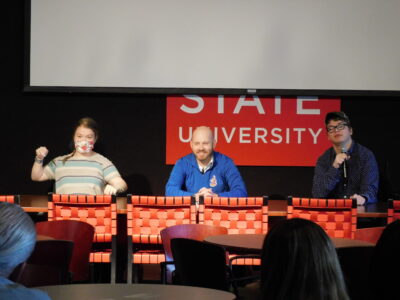
As a part of Developmental Disabilities Month, local comedian Kyle Erickson headlined a panel discussion at Minot State University to give the public a chance to hear firsthand how the disabled still inhabit a blind spot in society. Beginning with a comedy set, Erickson was then joined by Kellie Sem and Trampes Brown who shared anecdotes and answered questions. Nothing was off the table.
"I have a very visible disability, you can see it," said Erickson, who moves with the aid of a wheelchair, "I would argue the hardest disabilities are those you can't see, like ADHD (attention-deficit/hyperactivity disorder) or depression."
Erickson, a research associate at MSU, got into comedy when a friend was putting on an open mic in 2020. As a resident class clown, Erickson decided to put his money where his mouth was and signed up. Not only did he enjoy it, Erickson felt encouraged to dive in feet first, traveling around the region performing in open mics and even auditioning for "America's Got Talent."
"I feel like when a lot of people don't see that a person with a disability could be your neighbor or coworker. There's not that lived experience. All three of us are employed and community members. I don't want to use the cliche that we're just like you but it's true." said Erickson, "We're trying to deal with independence. We're trying to destigmatize it. Most of my jokes are about my experiences being in a wheelchair. A wise person once told me that if we can make fun of something it won't have power over you."
Trampes Brown, who lost most of his vision when he was 29 years old, doesn't have a driver's license and gets around mostly through public transportation and walking, sometimes with the aid of a cane. That is if his fellow Minot residents don't make it impossible for him to do so.
"For all of you that don’t clear the sidewalks, I'm coming for you. Those people that have like four cars and park them in your driveway and across the sidewalk; it drives me absolutely insane," Brown said, "Just because it's across the sidewalk and it's fine for you and your family, doesn't mean it is for everybody else. This is a major issue that I see within our community."
The panel all agreed that if there was one recurring awkward experience, they all could do without, it is being told they are inspirational. While the group acknowledged the notion can be affirming in small doses, it rings hollow and trite to them now, especially when they're being celebrated for doing something benign or normal.
"I'm so tired of being called an inspiration, I just want to be a schlub like everyone else. They say, oh you're an inspiration for just crossing the street or something. But anybody can walk, or in my case roll across a street. What's so special about that?" Erickson said, "If someone acts awkward around me, I'm gonna roast the crap out of you. Growing up I got myself into a lot of awkward situations and people didn't really know what to do with me. So, I'd just make jokes about it."
The panel covered a variety of other topics, from the typical treatment from strangers on the street or in bars, to the many considerations those with disabilities have to make regarding applying for jobs and finding suitable housing. Brown and Erickson both had very different approaches to the employment quandary, with Brown electing to be open about his vision while Erickson says he often doesn't disclose his disability on applications.
Sem, who also utilizes a wheelchair, says in elementary school she was often treated different from the other kids and was singled out in ways that still reverberate in her life today.
"My teacher in my first-grade class would treat me differently. She would tell the kids to say hi to me in the morning. She talked to me a different sing-songy voice. To this day when I see those kids, they still treat me a little differently and talk baby talk or talk down to me a little bit," Sem said.
As Sem pursued higher education, she desired to enroll in the pharmacy program at NDSU. Despite meeting with the State Board of Pharmacy and getting them on board, NDSU ultimately did not allow her to enroll in the program.
"I went down to NDSU, and I had been working for years to be a pharmacist. The State Board of Pharmacy was OK with it, but NDSU was not. That was a really challenging thing to get through and to realize that people will see your greatest limitation as your highest potential. That was a really hard lesson for me," Sem said, "I came back to Minot State and finished my chemistry degree. I can't say enough about Minot State and the home they have given me here."