COVID-19 drugs limited
Number of sick employees declines
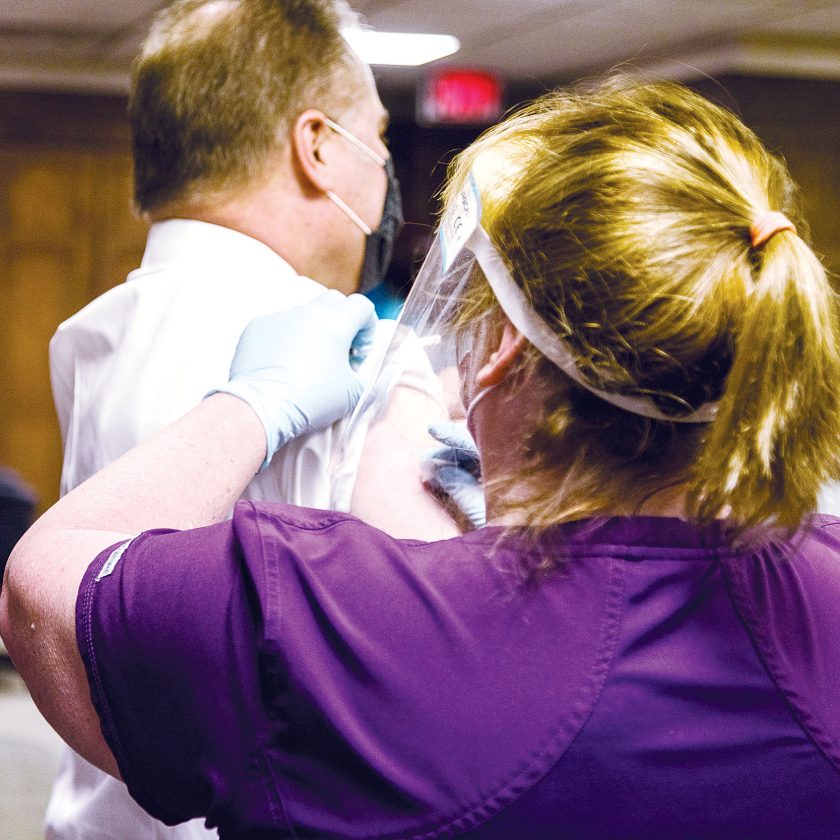
Submitted Photo A nurse at Trinity Health prepares a patient for a vaccine. Trinity officials stressed the importance of vaccinations in the prevention of severe symptoms from COVID-19.
COVID-19 cases among Trinity Health employees in Minot is down from last month and patients with COVID-19 has remained mostly steady, but Trinity officials still urge the public to take caution.
“It’s not quite over yet. Even though the numbers are dropping we’re still seeing some significant complications both with staffing and with patients,” said Dr. Scott Knutson, emergency room physician and member of the board of directors at Trinity Health. “We’re still asking the public’s help in doing the right things to prevent infection, doing the right thing to prevent complications of infection. We still see vaccinations as a big help in minimizing the severity of the disease.”
There were 24 total COVID-19 positive patients at Trinity on Tuesday. Two of those were in the Intensive Care Unit (ICU). In mid-January, that number hovered around 25 to 30, Trinity officials said.
“What I’m seeing in our ER still is any 24-hour period, we’ll still have 10 patients that present with COVID symptoms. We’re not admitting as many as we were before with severe disease. We have 22 people up on our COVID floor right now, a couple in the ICU. Many of them have outlived their infectious duration, and they’re just long COVID patients now. We’re losing some to discharge, kind of replacing at about the same rate. Our hospital numbers are still pretty static. It’s still pretty tight.”
Twenty-six Trinity employees were out with COVID-19 or COVID-19-related symptoms compared to 74 in mid-January when cases spiked across the state reaching an all-time high of 12,355 active cases.
“For the last two years, we haven’t had more than one doc down at a time in our ER group of the 11 of us, and we had five out in the last two weeks,” Knutson said. “It feels a little better this week than it was for a couple of weeks.”
Randy Schwan, vice president of Mission Integration at Trinity Health, said that while 26 is a low percentage of the 3,000 people that Trinity employs, absent workers still make an impact.
“Sometimes you can’t afford that 1%,” Schwan said. “It’s critical people.”
Trinity currently has a few drugs available for COVID-19 patients. The first is Strovimab, a monoclonal antibody that Knutson said has proven to be the most effective for the omicron variant and is administered at an infusion clinic intravenously. It works by inhibiting the replication of the virus, as do the two other medicines, Paxlovid and Molnupiravir.
The treatments are most effective if administered in the first half of the illness, Knutson said. He stated that once a patient has reached the point of requiring hospitalization, the effectiveness declines.
“All of those are most effective in the first half of the illness when the viral replication process is really taking off. That’s when it’s kind of spreading bodywide,” Knutson said. “The second half is when inflammation starts kicking in, and that’s when we start seeing some complications with breathing and we see all the inflammation in the organs.”
The hospital receives 10 to 12 doses of Strovimab a week. Schwan said that prior to the January spike in cases, they were receiving over 100 a week. Because of the scarcity, the hospital screens who receives it.
“We had more treatments than we had patients,” Schwan said. “Now it’s the flip side. We have more patients than we have treatments. The federal government, when they saw that distribution was going to be tight, took control over who gets it. The State Department of Health gets the allocation, and then distributes it to hospitals in the state. The distribution’s really been choked, so we have to prioritize the patients that get them because we don’t have enough for everybody.”
Patients at a higher risk for severe symptoms may be referred for treatment. Knutson said that could include people with a Body Mass Index (BMI) over 35, people over the age of 65, pregnant women, or those with heart conditions, asthma, chronic raspatory problems, chronic kidney disease, or diabetes.
“If somebody sees you at a point of care, they’ll put a referral in for you to be evaluated, and we’re trying to do that to kind of prioritize those at higher or highest risk for complications,” Knutson said. “We’ll keep giving it away as long as we have it.”
Local News
Felon charged after multi-agency investigation
A Minot man has been arrested and charged five felony counts for possession with intent to distribute marijauna and ...
Brine spill occurs near Killdeer
KILLDEER — A brine spill occurred at the Cougar 1 SWD site, about 20 miles northwest of Killdeer, Tuesday, March ...
Minot Municipal Court Dispositions
March 31 Talon Blake Hoaglund, 19, Minot, DUI/APC-first offense (Class B misdemeanor), chemical dependency ...

Air & Space Forces Association leader to speak at Minot AFB event
North Central District Court Dispositions
Mountrail County March 30 David Thomas Dwitz, 37, Tolley, DUI-0.16% or greater-first offense (Class B ...