
Construction progress continues on Northwest Area Water Supply project
Update on construction
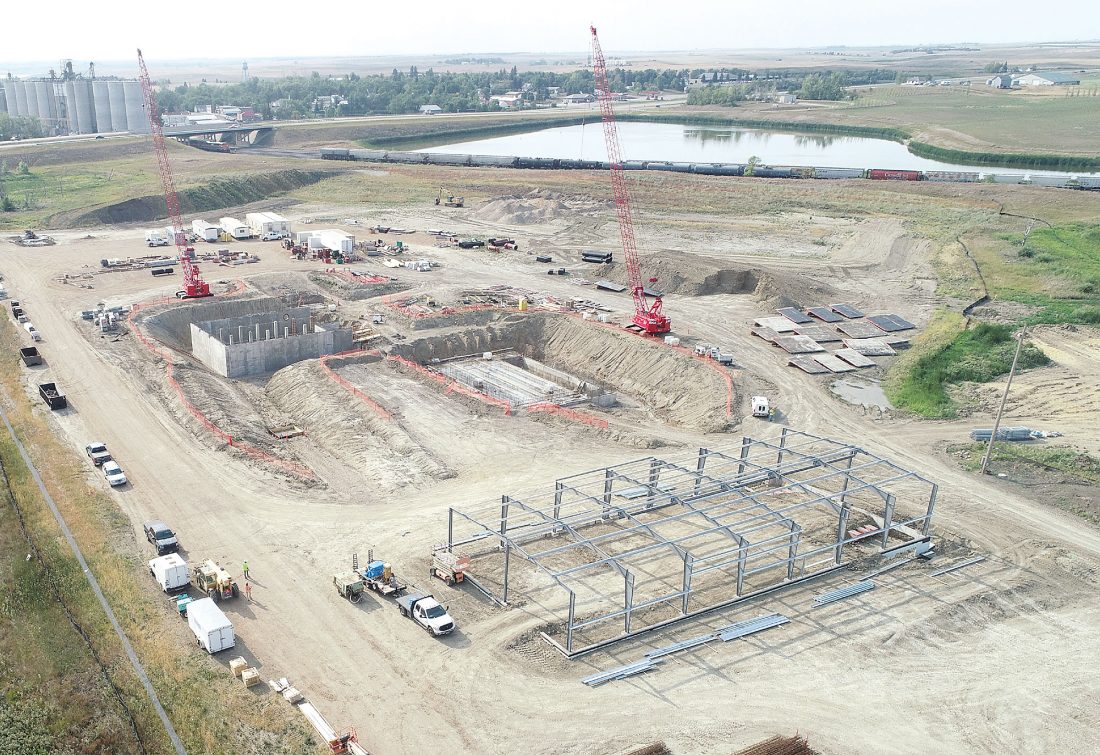
Submitted Photo As shown in this recent photograph, construction continues at the Max water treatment facility for the Northwest Area Water Supply project. Photo courtesy of North Dakota Water Resources.
MAX — Most construction projects are visible as they rise against a skyline. Not so with the Northwest Area Water Supply project, or NAWS, that is underway near here. Much of the work being done is at ground level or below on a facility that will treat Lake Sakakawea water.
“It will treat water to a certain level to prevent transfer of invasive Aquatic Nuisance Species,” said Tim Freije, North Dakota Water Resources and Section Chief for NAWS. “The Max facility is being built for that very purpose, specifically to stay in compliance with the Boundary Waters Treaty Act.”
The project spent about 17 years in litigation and underwent extensive environmental reviews, primarily due to concerns raised by the province of Manitoba, which was weary of unwanted biota entering their water system.
While the project was tied up in the courts, permission was granted to continue to construct a pipeline to bring Missouri River system water to Minot and beyond. However, said Freije, it won’t be until 2024 that water will be flowing to Minot through the NAWS pipeline.
One of the main elements of the project involves the Snake Creek Pumping Plant. The NAWS pipeline currently is in the ground from Minot to Totten Trail.
“It will actually cross the road to the south of Totten Trail, by the fish cleaning station,” said Freije. “We’ll be making modification to the Snake Creek Pumping Plant and replacing the northernmost pump to provide pressure to get water to the facility in Max.”
Even though the current pipeline end is situated on the Lake Audubon side of U.S. Highway 83, NAWS water will actually be drawn from Lake Sakakawea.
“We’ll take the northern-most of the three Audubon outfall structures out of service,” explained Freije.
The tunnels used to pump Audubon up to its summer operating level, using Lake Sakakawea water, are each 11 feet in diameter. The reason for drawing water from Lake Sakakawea, said Freije, comes down to water quality and that there’s “better water on the Sakakawea side.”
Lake Audubon is a “maintained” water level facility, 1,847 feet in the summer and 1,845 feet in the winter. Lake Sakakawea has much more water level movement which helps avoid certain water quality issues that could arise on Lake Audubon.
The Snake Creek Pumping Plant, said Freije, currently operates at only 3% of capacity. Also, because the Max treatment plant is for Boundary Waters Treaty compliance, it is a federal responsibility for both construction and operational costs, meaning Minot is not cost-sharing with the state on the Max biota facility as it does with the remainder of the NAWS project.
Construction also continues on another aspect of the project, this one near Lansford. Basically, it is the main storage and pumping point for distributing water to the All-Seasons Water Users district.
“It’s for all the northern tier, from Bottineau to Kenmare,” explained Freije. “We’re building a water tank, 150 feet in diameter, a 35-foot-tall reservoir with a concrete dome over the top, and pumping station.”
Completion of the Lansford project is expected next year. The Max treatment plant is expected to be completed in early to mid-2024.
“We should be able to treat water then,” remarked Freije. “We’ll still be working on other details like landscaping, parking lots, and striping.”
Local News
Funds available to improve maternal health in ND
FARGO – Organizations supporting maternal health care in North Dakota are invited to apply for a Maternal Health ...

Western Plains Opera, MSU Theatre to present ‘Chicago’

Minot to escape worst of snowstorm
Parenting book study begins April 8
A free book study on “Raising Good Humans” will be held online on Tuesdays from April 8 through May 6 at 6:30 ...

Local event benefits military members at Minot AFB
Minot Symphony Orchestra to present ‘Pirates of the Caribbean’
The Minot Symphony Orchestra will present Disney’s "Pirates of the Caribbean: The Curse of the Black Pearl" in ...