
‘Our Story’
New book says famed guide Sacagawea was Hidatsa and Crow
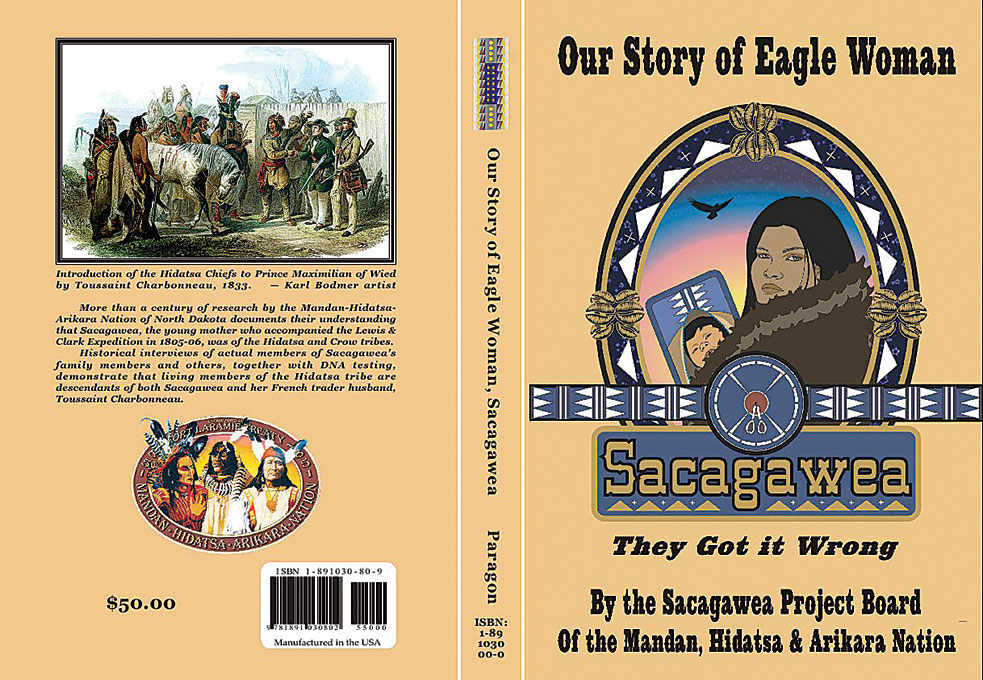
Submitted Photo This is the front and back cover of the Sacagawea Project Board of the Mandan, Hidatsa and Arikara Nation’s new book, “Our Story of Eagle Woman: Sacagawea. They Got It Wrong.”
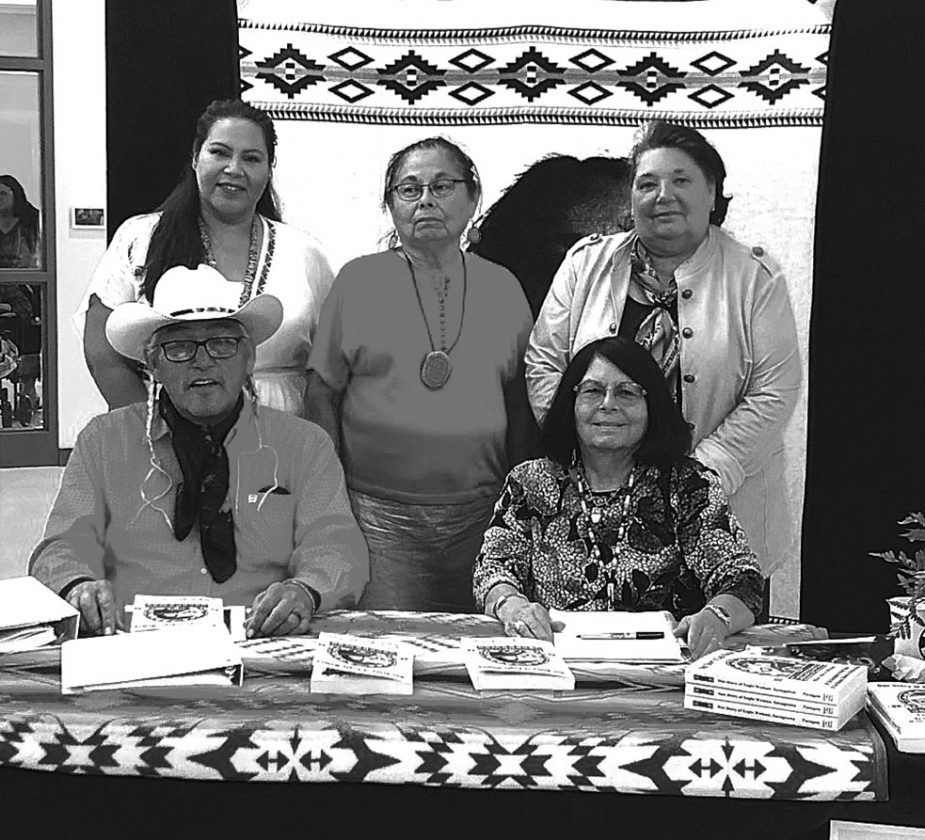
Submitted Photo Shown at the book-signing for the new book, “Our Story of Eagle Woman: Sacagawea. They Got It Wrong,” are front row, from the left, Gerard Baker and Jerry Birdsbill Ford, and back row, from the left, Shanna Sheppard (standing in for Wanda Sheppard), Sharon Fredericks (standing in for Carol Fredericks Newman), and Claryca Mandan. The release of the book and book-signing was held Aug. 14 at the MHA Interpretive Center, west of New Town.
Submitted Photo This is the front and back cover of the Sacagawea Project Board of the Mandan, Hidatsa and Arikara Nation’s new book, “Our Story of Eagle Woman: Sacagawea. They Got It Wrong.”
Submitted Photo Shown at the book-signing for the new book, “Our Story of Eagle Woman: Sacagawea. They Got It Wrong,” are front row, from the left, Gerard Baker and Jerry Birdsbill Ford, and back row, from the left, Shanna Sheppard (standing in for Wanda Sheppard), Sharon Fredericks (standing in for Carol Fredericks Newman), and Claryca Mandan. The release of the book and book-signing was held Aug. 14 at the MHA Interpretive Center, west of New Town.
Trending
NEW TOWN - Tribal members on the Fort Berthold Reservation have long maintained that Sacagawea, the well-known female guide who helped the Lewis and Clark Expedition on its travel to the Pacific, was Hidatsa and Crow contrary to accounts that say she was Shoshone.
This month, the Sacagawea Project Board of the Mandan, Hidata and Arikara Nation released its book, "Our Story of Eagle Woman: Sacagawea. They Got It Wrong." A book-signing event was held Aug. 14 at the MHA Interpretive Center, west of New Town.
"We have DNA records to back it up," said Jerry Birdsbill Ford, who worked on the research and writing the book. "We also have the BIA (Bureau of Indian Affairs) history enrollment cards."
Gerard Baker, PhD, a member of the Sacagawea Project Board, said Sacagawea's original name was Maeshuwea which means "Eagle Woman."
She became known as Sacagawea or "Bird Woman."
"We think Sacagawea is the closest correct pronunciation of "Bird Woman," Ford said.
(As for the North Dakota spelling of Sakakawea, a 1967 story in The Minot Daily News said when President Lyndon B. Johnson signed a bill officially naming Garrison Reservoir as Lake Sakakawea, that the double "k" in her name translates as "Bird Woman.")
Baker explained how the recent research, its findings and writing a book came about.
"It actually started when we were all little and listening to the stories," he said.
A few years after the Lewis and Clark Bicentennial Celebration many of the descendants of Sacagawea and others came together for a summit in Mandaree in 2015, with Jerome Dancing Bull as emcee. There they talked about Sacagawea, what they knew and had heard.
Dennis Fox Sr. and his wife, Sandra, both with PhDs, moved the effort forward to research and write a book about Sacagawea.
They started looking at forming a board and approached the Three Affiliated Tribes business council on the Fort Berthold Reservation with their plan. Randy Phelan, vice chairman of the council at the time and representing Mandaree where many of Sacagawea's descendants live, agreed to help finance the project. There are many other descendants on the reservation as well and other segments of the reservation also added money for the project.
Dennis and Sandra Fox formed a board to oversee the project comprised of Gerard Baker, Calvin Grinnell, Bernie Fox, Carol Newman and Wanda Sheppard – all relatives of Sacagawea.
Quincy Baker, Claryca Mandan and Ford also worked on the project and writing the book.
Michael Welsh of the University of Northern Colorado also worked on the research.
Dennis and Sandra Fox managed the development of the book.
Delores Sand of New Town, who also helped with the project, is a direct descendant of Sacagawea through her father, George Parshall, and his family members related to Cedar Woman. Cedar Woman was Sacagawea's daughter.
Many other people helped with the work as well.
"Lots of folks came forward who had good expertise in research," Gerard Baker said.
The project for the Sacagawea Project Board covered six years and used oral histories, Bureau of Indian Affairs enrollment cards, trappers' notes saying Sacagawea's son, Jean Baptiste, said he was half Crow, and DNA evidence showing that Sacagawea was Hidatsa/Crow, Ford said.
Sacagawea's father was Hidatsa and her mother was Crow. The Hidatsa and Crow were one tribe before Sacagawea's era, Ford said.
Knowing the importance of DNA to the project, to obtain DNA evidence initially Ford went to California for DNA of Jean Baptiste's descendants. This led to further research of Sacagawea's family at Spirit Lake Reservation.
The book has 22 chapters and more than 300 pages.
Baker said it includes extensive history and many pictures. He said there are many family stories in it.
The book was published by The Paragon Agency, a book publishing company owned by Douglas Westfall and focusing on American history.
"This is mainly for our children and the future. I think it's going to be a treasure forever," Baker said. Through the project, he said, "I learned a lot, and I study history every day."
The committee sees future opportunities for more research about Sacagawea.
"We would like someone to take it up and do further research for a potential thesis," Ford said.
All the money from the sales of the book will go to the MHA Interpretive Center, with an emphasis on its cultural programs, Baker said.
The book is available for $50 in hardbound at the interpretive center gift shop.