
Two construction projects to take place on Burdick Expressway in Minot
Burdick becomes construction zone this season
Trending
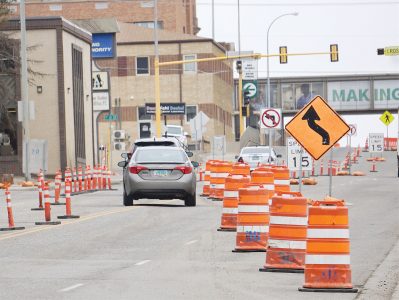
Orange traffic barriers, lane closures and a lowered speed limit have greeted motorists traveling Burdick Expressway through downtown Minot in recent days.
Two separate projects will require motorists and pedestrians to exercise extra caution along that section of roadway for much of this coming construction season. The first project, involving water main and storm sewer replacement, has slowed traffic to 15 mph through a tighter traffic area as contractors have begun preliminary work.
"Our intent is to use trenchless technologies, such as pipe bursting or horizontal directional drilling, to replace the water main under Burdick Expressway and along First Street Southwest from Fifth Avenue to Burdick Expressway," said project manager Jesse Berg with the City of Minot Engineering Department.
Essentially, the work is on Burdick from Main Street near Trinity Hospital for two blocks to the east and one block on the west side of Trinity.
Post Construction was awarded the project for $629,644.
Additionally, the first project will replace poorly functioning storm sewer on the south side of Burdick at the intersections of First Street Southwest. Main Street and First and Second Street Southeast.
Berg said the city and contractors are prepared, if necessary, to temporarily detour traffic from Burdick during this first project. If that should happen, the closures could only occur during the slower traffic period from 6 p.m. to 6 a.m.
The city also prepared for motorists to optionally choose to detour through downtown by turning a two-way stop at First Street and Second Avenue Southeast near Central Campus into a four-way stop.
Some construction accommodations are being made due to the presence of the hospital next to the work zone. Berg said compactors that cause vibration are being limited to certain hours to avoid potentially disturbing day-time hospital activities.
Additional signage was added near the hospital to alert traffic to pedestrians. Despite the lights at Main Street flashing yellow, motorists must yield to pedestrians. A crosswalk is striped on the roadway to indicate where pedestrians should cross.
Berg said the city worked with Community Ambulance and the local fire department to maintain emergency access in that area and made area ambulance districts aware of the traffic changes. Motorists should watch for and yield to emergency vehicles traveling Burdick or entering or exiting hospital property.
Whenever possible, residents needing to access the hospital's emergency room entrance should park on the north side of Burdick and use the pedestrian crosswalk to reach the hospital on the south side.
Berg said the work on the first project should be substantially complete in mid- to late June. From that point until after the North Dakota State Fair, traffic should flow as normal.
After the fair, the North Dakota Department of Transportation will begin the second project, which includes construction of disability-accessible sidewalk ramps from 16th Street Southwest to 27th Street Southeast. There will be localized lane closures as work progresses on ramps to move pedestrians both east and west and across Burdick at designated intersections.
Berg said most blocks will need the ramps. Even where ramps already exist, many don't meet requirements of the Americans with Disabilities Act and will be replaced.
The second project also includes updated traffic signals along Burdick at Main, Third and Valley streets and mill and overlay work on Burdick from First Street Southwest to Valley Street. The new signals will allow for better timing of lights for more efficient traffic flow.
The installation of new flashing beacons at the existing pedestrian crosswalk on Burdick is included in the more than $2 million cost on the second project. The city's share is just over $1 million. The project should be completed by the end of October.
Berg said the second project should result in somewhat less traffic disruption because intersections won't have to close and vehicles won't need to shift into lanes typically used by opposing traffic.
"Generally, they'll be keeping traffic within their normal travel lanes and either working on the outside lanes or the inside lanes," he said.
Berg noted the work on Burdick is a lot for one construction season, but the two projects were coordinated to ensure that underground infrastructure could be taken care of before the roadway is improved over the top of it.
Although it means an extended period of orange barrels and cones, he said, the restrictions provide safety for the public and the contractors.
"If we have a little more restrictive traffic control, they can get it done safer and oftentimes quicker," Berg said. "Just move through the traffic control slowly, steadily and safely."