
Trinity Health vaccinates 250 staff for COVID-19
Trinity vaccinates 250 health staff in first round
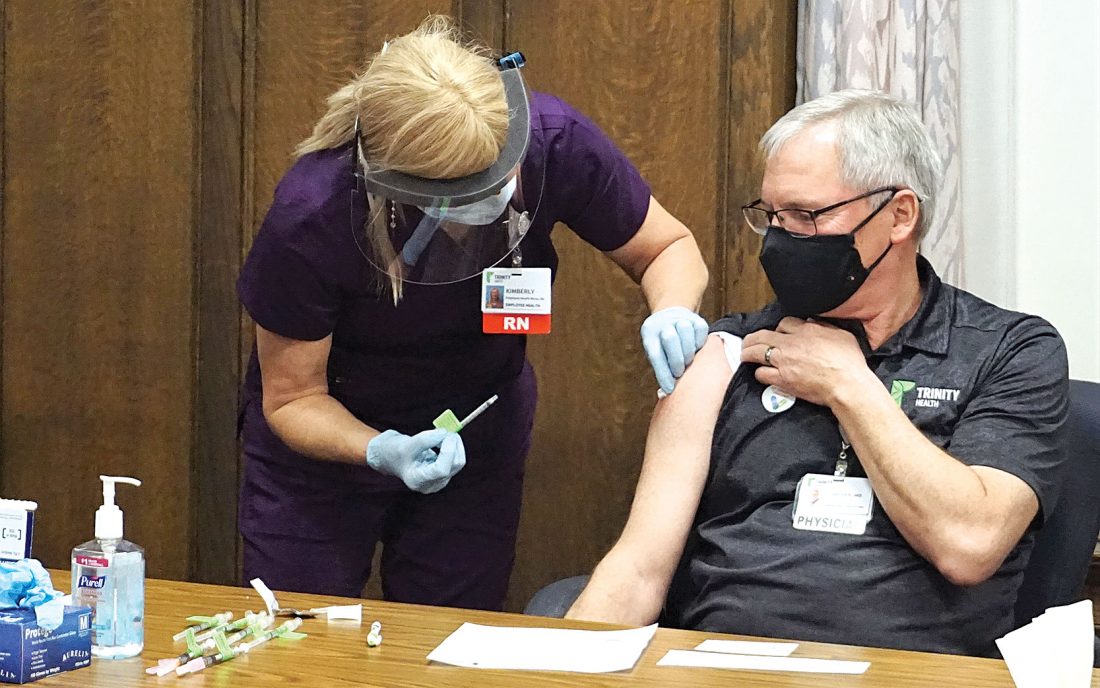
Jill Schramm/MDN Trinity Health nurse Kimberly Thompson prepares to inject Dr. Jeffrey Sather during Friday’s vaccinations at Trinity Health. COVID-19 vaccinations began at 7 a.m. for 250 workers in the first round. Additional vaccinations are expected to occur Tuesday.
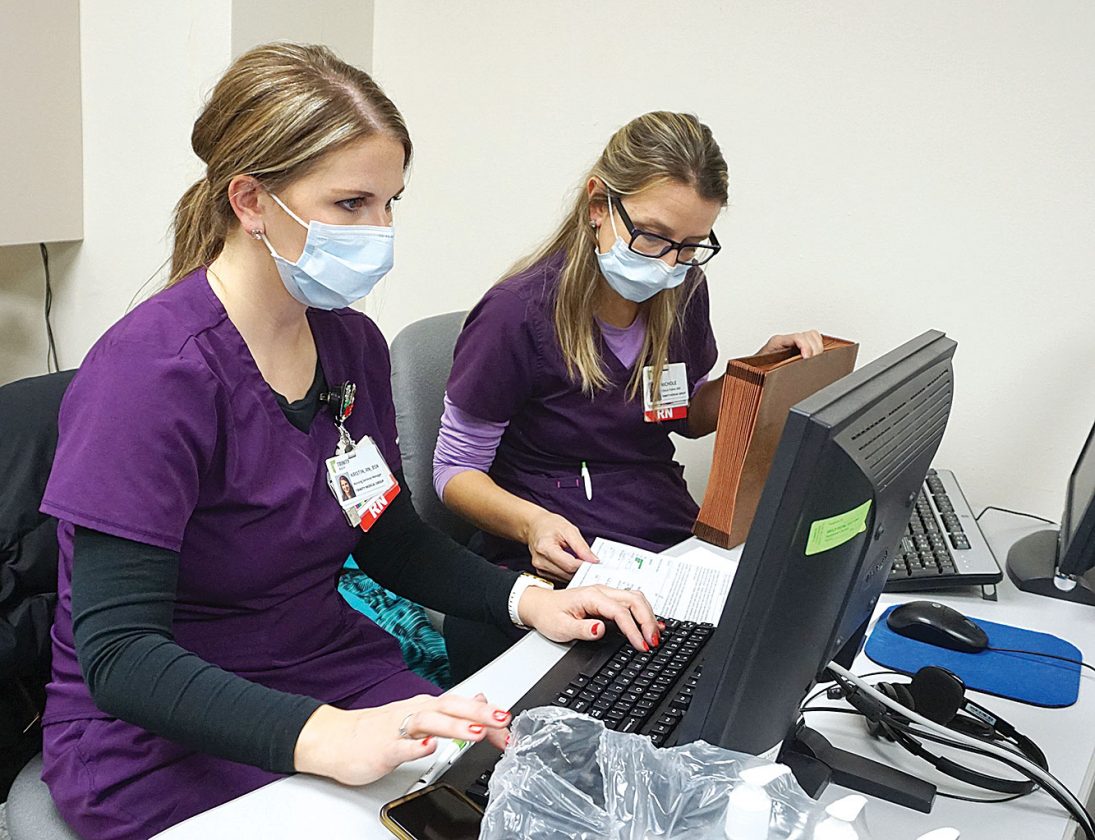
Jill Schramm/MDN Trinity nurses Kristin Settersten, left, and Nichole Oswalt process information regarding Trinity staff vaccinations Friday. They served on a team of workers converting registrations to appointments, verifying vaccinations and documenting vaccine lot numbers and site of injections.
Jill Schramm/MDN Trinity Health nurse Kimberly Thompson prepares to inject Dr. Jeffrey Sather during Friday’s vaccinations at Trinity Health. COVID-19 vaccinations began at 7 a.m. for 250 workers in the first round. Additional vaccinations are expected to occur Tuesday.
Jill Schramm/MDN Trinity nurses Kristin Settersten, left, and Nichole Oswalt process information regarding Trinity staff vaccinations Friday. They served on a team of workers converting registrations to appointments, verifying vaccinations and documenting vaccine lot numbers and site of injections.
Trending
After months of trying to help his patients survive what he calls "COVID hell," Dr. Jeffrey Verhey took his biggest swing against the disease Friday when he stepped up to become among the first frontline healthcare providers at Trinity Health to receive the COVID-19 vaccine.
"For the first time in months and months, I feel like we're playing offense against COVID-19. We've been playing defense all this time. Our behaviors have been defensive. Our reactions have been defensive. This is the first time we've been able to play offense against this disease. And for all of us, thinking about this vaccine, I think we should get on that offense and go after it, and protect ourselves, protect our communities, protect the vulnerable," said Verhey, a pulmonary and critical care physician.
Trinity Health vaccinated 250 workers Friday and expects to vaccinate another 250 workers Tuesday, pending a second shipment of the Pfizer vaccine.
Dr. Jeffrey Sather, chief of medical staff, said Trinity expects to vaccinate all workers across its system who want to be vaccinated before mid-January. After that time, doctors will be identifying their high-risk patients to be next in line, he said. Community members with risk factors can contact their physicians if they have questions about that process.
Along with Verhey, Sather and his wife, Mary, who also works for Trinity in sleep technology, received doses of Friday's vaccine. Those vaccinated Friday will receive a second dose Jan. 8.
"I'm happy to have gotten to this day," Dr. Sather said. "My risks are minimal with this vaccine, and they were great with getting the disease."
"It's really good for me - a bit of confidence, knowing that I've got that protection. I think everybody who works on the frontlines should be vaccinated, so that they can have the same level of confidence," Verhey said. "It's important for us to maintain our service line as much as possible so I felt the need to get vaccinated, so that I could stay healthy and stay well so I could help take care of patients in the ICU."
Verhey said the number of COVID-19 patients hospitalized at Trinity has declined somewhat. However, COVID-19 patient numbers in the intensive care unit have been increasing over the past week or so. Verhey said once on a ventilator, a patient can take weeks to get better, stacking up the number of patients in the ICU.
"It's what I call COVID hell, because those patients are going through a lot. They are without their families. They are sedated. They are on a ventilator, and they have to struggle to go through their hospital stay in the ICU. It is an absolute horrible thing for these patients to go through," he said.
Verhey said getting the virus under control is a three-legged stool, with medications, public mitigation measures and a vaccine.
"Today is the first time that we've been able to put a solid leg under that stool," he said.
A handful of individuals who spoke with media about their experiences with the vaccination reported no ill effects - or really any effect at all following the shot.
Sather said it is important for community members to get vaccinated when their times come because it's the only way to stop the disease.
"Even though our numbers now have gone down greatly, we're still seeing positive patients. We're still seeing young, relatively healthy people get very sick," he said. "For anyone to think they're very low risk for this is a false thought for them to have."
He also urged people to not lower their guard over the holidays, which could cause a resurgence of the virus in the community.
The local medical community is promoting the vaccine as safe. Sather credited the rapid development of the vaccine, in part, to previous laboratory research into coronaviruses.
"It just shows what we as human beings can do when we focus our efforts into what needs to be done," he said. "This vaccine is well tested, and it's more tested than a lot of them that have hit the market."
Dr. Gary Wease, chief of trauma surgery, noted public mitigation measures such as social distancing and mask wearing will need to continue until a vast majority of the population is vaccinated. Getting vaccinated is one measure that can help reduce the spread, though, he said.
Wease said he chose to be vaccinated Friday because he doesn't want to carry the virus to others.
"But more important than that, I think it shows that I believe that it's effective. I believe that it's safe to have, and it protects my colleagues and protects our community," he said.
Trinity selected the first workers for vaccinations based on surveys of its nearly 3,000 employees. Employees were required to view educational materials related to the vaccine before taking the survey, which asked about their willingness to be vaccinated and how early in the process they wanted to participate.
Sather said the vast majority of employees opted for the vaccine. The numbers split fairly evenly around timing of the vaccine, as workers who felt their jobs to be lower risk were more willing to wait, he said. A committee then selected those at highest risk for the first round of vaccinations, including employees working directly with COVID-19 patients.
ICU nurse Ashley Deaver said it is exciting to see the light at the end of the tunnel. She chose to be vaccinated to stay healthy so she can care for her patients, but her choice also was influenced by the hardships she has witnessed.
"It's been tough," she said. "We've seen how hard COVID has hit patients, families and even co-workers. We've been doing it for nine months, and these last few have been the toughest. We've seen pain, suffering, loss. But now we can look forward to some hope. It's refreshing."