
Pandemic heightens need for ID verification in ND
Pandemic heightens need for ID verification
Millions of American workers may be unemployed during the pandemic, but fraudsters are working harder than ever. Much of that hard work is aimed at stealing pandemic unemployment assistance.
“The sheer scale of the fraud is truly astounding,” said Blake Hall, CEO of the identity verification firm ID.me. “It is shaping up to be, by far, the largest fraud attack on the United States of America ever.”
The State of North Dakota recently contracted with ID.me, directing unemployment insurance beneficiaries to the agency to verify their identities. About 98% had done so before Christmas, according to Job Service spokesperson Sarah Arntson.
Arntson said beneficiaries received letters regarding a possible delay in payments with the new process, but the hope is that beneficiaries will see their money delayed by only a few days.
Hall said 90% of people looking to verify their identities with ID.me do so through an automated service that takes less than five minutes. For people who need to talk to a representative, ID.me offers a video chat option.
Hall said wait time for the 10% of people who use video chat had wavered between 30 minutes and two hours last week but since has dropped to two minutes. The chat itself takes about five minutes.
Wait time increased temporarily when the State of Arizona sought to verify 230,000 existing claimants, Hall explained.
The company is confident at least 30% of claim applications for pandemic unemployment assistance are fraudulent. ID.me has worked with North Dakota only about two weeks, but, at this early stage, it appears the amount of attempted fraud is roughly similar to other states, Hall said.
Fraud is generated by enemy nation states, foreign organized crime rings and domestic situations, such as elderly individuals having their identities stolen by caregivers, he said.
The most powerful defense against fraud is your phone, Hall said. Crime rings might have all your personal data but if they don’t have possession of the phone, they won’t pass a verification process that requires the phone number tied to the person’s identity and access to the device.
“We assess that we’re blocking at least 20% of fraud on that alone,” Hall said.
However, he added, 10% of fraudulent claims involve scammers persuading people to give up valuable information.
“They are succeeding about 20% of the time. So 20% of the time, the victim will actually give them their personal information, give them their government ID, even give them their log-in credentials to their wireless carrier,” he said.
In addition to North Dakota, ID.me is working to ward off scams in pandemic unemployment assistance in Florida, Georgia, Texas, Nevada, Arizona, California, Washington, Montana, Pennsylvania and Indiana. That list is growing, and about a third of existing states also use ID.me for traditional unemployment assistance.
“We are essentially taking away a significant revenue stream for organized crime,” Hall said. “If you look across all the states that we serve, we blocked over 557,000 fraudulent claims. The potential loss to taxpayers is over $5.6 billion from those claims.”
One of the nation’s top identify verification companies, ID.me is federally certified through the Commerce Department. Based in McLean, Virginia, the company was founded in 2010 by Hall, a former Army Ranger who fought in Iraq and attended Harvard Business School.
With 31 million users already, the company adds a million new users seeking identity verification every 17 days, Hall said. He estimated the company has verified more than 10% of America’s population to some degree.
ID.me supports 405 organizations, including multiple federal agencies, such as Veterans Affairs and Social Security, and major national corporations. Individuals who create accounts with ID.me can use that account information to log into their accounts on Social Security or Veteran Affairs websites.
Hall noted ID.me does not sell or share anyone’s data. Individuals can control who sees their data, revoke ongoing sharing or destroy their ID credential and associated data.
“It’s the individual’s right to say, ‘Yes, I want to share this aspect of who I am with this government agency to get this benefit.’ We make sure that the government agency can trust it,” Hall said.
Local News
Funds available to improve maternal health in ND
FARGO – Organizations supporting maternal health care in North Dakota are invited to apply for a Maternal Health ...

Western Plains Opera, MSU Theatre to present ‘Chicago’
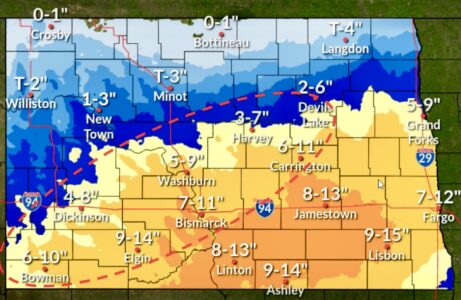
Minot to escape worst of snowstorm
Parenting book study begins April 8
A free book study on “Raising Good Humans” will be held online on Tuesdays from April 8 through May 6 at 6:30 ...

Local event benefits military members at Minot AFB
Minot Symphony Orchestra to present ‘Pirates of the Caribbean’
The Minot Symphony Orchestra will present Disney’s "Pirates of the Caribbean: The Curse of the Black Pearl" in ...