
Flood concerns grow
Trending
Will the heavy snowpack in the Minot region lead to excessive runoff next spring?
That's the question many Souris River Valley residents have on their mind, especially if they endured the historic flood of 2011. While it is much too early in the winter to say with any precision what will occur in the spring, the snow on the ground is certainly an important factor in any upcoming runoff scenario.
However, the correlation between snowpack and runoff is not always as ironclad a conclusion as one might think. There's far more factors that go into a high runoff season than snowmelt, but let's compare the current snowpack conditions in Minot with the same period in 2010-2011.
According to Hydrologist Allen Schlag in the Bismarck bureau of the National Weather Service, the Nov.-Dec. snowfall total in Minot was 43.4 inches as of Wednesday morning. The total snowfall for Nov.-Dec. in 2010 was 42.3 inches. The Souris River Basin experienced heavy flooding in 2011 but it was produced by a combination of snowmelt and rainfall, not snowmelt alone.
"In the next six years of rankings after 2011, not one of those years had a flood in the top 22. That's pretty important," said Schlag. "There's definitely a multitude of things that have to go into creating a flood. First and foremost you have to have water and it doesn't necessarily have to come from the snowpack."
How much snow falls during each measurable weather event is not a perfect science. An example comes from the North Central Research and Extension Center where they have measured snowfall and rainfall for many years. Following the recent Christmas blizzard the initial report from that location was that 13 inches of snow had fallen. The amount was later adjusted to 17 inches.
"We're trying to record what's going on with 45 mile per hour winds," said Jim Tarasenko, Extension Center. "How do you average it out?"
Snowfall, said Tarasenko, is measured in a canister that is two feet deep and approximately one foot in circumference. There is a wind barrier around the canister but it is not considered adequate protection against 45 mph winds.
"I just hate trying to come up with snow totals," said Tarasenko. "It kind of makes a difference where you are recording."
A NWS observer southwest of Minot reported 22 inches of snow from the recent blizzard.
"When snow blows it is really hard to measure," said Janine Vining, Bismarck NWS meteorologist. "From Bismarck up through Minot and Kenmare, that looks like it was the worst."
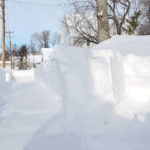
What is obvious is that the actual snowdepth in any particular area of Minot and the surrounding region, is substantial and quite extraordinary for this time of year. At the Extension Center the snowfall thus far this winter totals 42.5 inches. That compares to the 2010 total at the same location of 47.8 inches of snow on Dec. 31. In early 2011 another 36.3 inches of snow fell in Minot for a winter total of 84.1 inches.
The average snowfall for Minot in December, derived from 112 years of record keeping, is 7.9 inches, far less than what is already on the ground. The January average is 10.8 inches, February 5 inches and March 7 inches. If Minot were to receive only average snowfall through March it would bring our winter total to approximately 65 inches, enough to push the total well into the record books.
We've got 10 more weeks before we can even think about no further snow accumulations, said Schlag. "Regrettably, we had a very wet August and September in North Dakota and Saskatchewan was wet. The end of November storm came with rain and a lot of snow on warm ground. We wetted up our soils into the 90 percentile. That's not conducive to snowmelt runoff in spring."
Of course conditions can, and likely will, change a great deal before any snowmelt will get underway. Still, there is concern that the ground may remain frozen when the runoff begins. If that would occur, snowmelt would run off much quicker than if it had an opportunity to soak into dry soil.
"Ground of the frozen type tends to enhance runoff," explained Schlag. "That's not good news. I don't like the soil conditions."
Southern Saskatchewan has seen snowfall totals similar to the Minot region. Notable is that most of the snow in the province that would enter the Souris River drainage has fallen in the region below both the Rafferty Dam at Estevan and the Alameda Dam at Oxbow. That means any runoff from that region would be unregulated until it reaches Lake Darling Dam northwest of Minot.
Heavy snowfall has also been recorded over the Des Lacs River Basin. The Des Lacs is subject to rapid runoff because it is situated in a valley with numerous deep coulees leading directly to the river. The Des Lacs enters the Burlington Project area before joining the Souris River and continuing into Minot.
"If there's a river system that has my attention more than any other, it is the Des Lacs," said Schlag. "There's no dampening on the Des Lacs. If there's a risk of springtime flooding right now, it's the Des Lacs. It has just a ton of coulees."
While a deep snowpack remains an important contributing factor to spring runoff, it must be remembered that weather conditions at the time of runoff remains of critical importance as to whether the runoff will be rapid or drawn out over several days or weeks.
The good news is that no snow storms are on the foreseeable radar for the NWS, but the Minot area is poised to undergo a weather change. Cold weather is on the way.
"On Friday there is a clipper, a windy system coming in from the north," said Vining. "By the weekend we'll see colder temperatures. By mid-week next week we could have high temperatures below zero with overnight lows 10-15 below, something like that."
Vining attributed the region's early winter storms to an active jet stream bringing a lot of storms from west to east across the globe. Tarasenko said he is not surprised by the amount of snow, saying it is similar to what fell in 1998 following the last major El Nino. El Nino, a warming of Pacific Ocean waters, is credited with producing Minot's unusually warm winter a year ago.