
WCE employees seek wages after closure
A Bakken oilfield company that closed in May, reportedly wiping out investors and leaving employees unpaid, was the victim of business misfortunes, according to former investors.
Employees of WCE Oil Field Services released a statement in July claiming they have sought without progress to obtain unpaid wages. They stated about 100 employees were not paid their final two or three weeks of wages, but investors say everyone from management on down, and including themselves, lost money when the company folded.
Health insurance also was canceled retroactively, leaving workers with no insurance from 20 days prior to employment termination, even though premiums were taken from paychecks.
Blue Cross Blue Shield confirmed that it canceled the company’s group insurance for lack of payment. The insurer stated its contract was with the employer rather than individual employees, and its practice is to cancel if payments aren’t made.
The North Dakota Insurance Department released information about contacts made with its office by three employees. One employee was on leave for cancer treatment when he learned of the terminated insurance. There were no official complaints filed with the insurance department because the policy is considered to have been terminated by an action of the employer, not the insurer. Employees were given information on obtaining other insurance.
The North Dakota Department of Labor reported receiving 15 complaints of unpaid wages, which were pending investigation at the end of July.
Former investors stated in a letter to employees that the decision not to pay employees was made by Wells Fargo, which called WCE’s loan, forcing the company to discontinue operations.
Wells Fargo provided the following statement: “We cannot speak to the specifics of the client relationship with WCE Oilfield Services or the unfortunate difficulties their employees might be experiencing. We had, for several months, diligently worked with company owners to reach a resolution, and now are working through the court-appointed receiver to conclude this matter.”
WCE had been in existence six years, founded by Todd Louis to provide residential earthwork services in Minnesota. The company later moved into North Dakota and transitioned into serving the oil and gas industry. Headquartered in Fargo, it had locations in Stanley, Dickinson and Watford City. An industry publication, in a spring 2015 article on the company, reported it had 300 employees and was the fourth largest employer in Mountrail County.
In August 2014, a group of private equity investors in Minnesota purchased about 65 percent ownership of WCE. In background provided by former investors, it was recounted that one of the original owners sold all his stock, while two other original owners sold 75 percent and remained as executives in the business. A new bank loan covered the pre-existing bank debt at the time. WCE also had several equipment loans, personally guaranteed by the original owners.
With the sale of the company, new investors joined the board of directors with the two original owners, and new executives joined the company. The field-based management team remained the same.
Upon closing the sale, WCE encountered several business misfortunes, according to the former investors. One business arrangement with a company called Caliber soured over a disagreement over a bill, and WCE came up $1.2 million short. When costs were more than double the bid on a pipeline project, WCE took a loss of nearly $2.4 million. WCE incurred another $2.5 million in costs on a second pipeline project for re-testing due to faulty work by a testing company. That contract also inadvertently failed to include the winter premium for hourly charges, costing WCE nearly $1 million.
The crash in oil prices caused business to dry up, leaving WCE unable to recoup its losses. WCE initiated a lawsuit against Caliber and against the testing company but struggled under cumulative losses of more than $6 million.
New investors and an original owner increased their investment with an infusion of about $3 million. It failed to save the company, though, and Wells Fargo called its loan.
“The senior lender, while taking action that was devastating to WCE, acted in what we see as a customary and understandable fashion, given WCE’s losses and poor prospects for repayment of the debt,” investors wrote. “This happened very rapidly, and without notice. The bank’s decision to not pay the last payroll was upsetting to us all, and was completely unexpected.”
They reported all new investors lost their original and follow-on investment. While original owners did receive funds in the original closing, they lost all their retained investment in the company. Creditors are unlikely to receive full payment, they said.
Investors reported that management team members took significant pay cuts in March, and all failed to receive any compensation for the last payroll period, even though they were not responsible for the problems but rather worked to resolve issues in hope that WCE could succeed. Management team members also were investors in WCE and lost those investments as well as their jobs and final pay.
Under bankruptcy law, secured creditors and trustees are paid first from any assets a company has remaining. Of unsecured creditors, employees who are owed wages have a priority, up to $10,000 per individual. Payment is based on the debtor having assets available, though.
Reimbursement for withheld insurance premiums never remitted to the insurer also can be sought in a bankruptcy proceeding. The Employee Benefits Security Administration in the U.S. Department of Labor is responsible for enforcing and addressing violations of the Employee Retirement Income Security Act, which covers employee benefit plans.
Local News
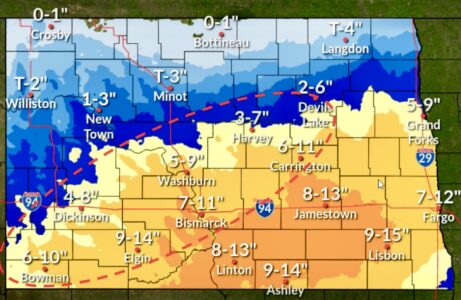
Minot to escape worst of snowstorm
Felon charged after multi-agency investigation
A Minot man has been arrested and charged five felony counts for possession with intent to distribute marijauna and ...
Brine spill occurs near Killdeer
KILLDEER — A brine spill occurred at the Cougar 1 SWD site, about 20 miles northwest of Killdeer, Tuesday, March ...
Minot Municipal Court Dispositions
March 31 Talon Blake Hoaglund, 19, Minot, DUI/APC-first offense (Class B misdemeanor), chemical dependency ...

Air & Space Forces Association leader to speak at Minot AFB event
North Central District Court Dispositions
Mountrail County March 30 David Thomas Dwitz, 37, Tolley, DUI-0.16% or greater-first offense (Class B ...