
GNDC survey finds business optimism
Screen Photo Source: Greater North Dakota Chamber
Screen Photo Source: Greater North Dakota Chamber
Screen Photo Source: Greater North Dakota Chamber
Screen Photo Source: Greater North Dakota Chamber
Trending
BISMARCK- The results of its annual North Dakota Economics and Employer Survey reveal a business community that remains resilient and optimistic, according to the Greater North Dakota Chamber (GNDC). The survey provides insight into the economic outlook, operational challenges and policy priorities of North Dakota’s businesses.
The survey found 89% of respondents reporting profitability and 86% rating North Dakota’s business climate as pro-business. However, workforce shortages, rising costs and regulatory uncertainty continue to challenge employers and influence future growth.
“North Dakota has built a strong business climate, and these results reflect that,” said Arik Spencer, GNDC president and CEO. “But maintaining that advantage requires understanding what businesses are experiencing today and what they need to remain competitive tomorrow. This survey gives us a direct perspective from employers to help guide those conversations.”
Key findings from the 2026 survey include:
- Workforce remains the top concern, with 59% of businesses reporting difficulty hiring employees and 74% of those experiencing challenges citing a lack of qualified applicants. Only 34% of respondents believe high school graduates are well equipped with basic academic knowledge and 14% say graduates have necessary workforce soft skills.
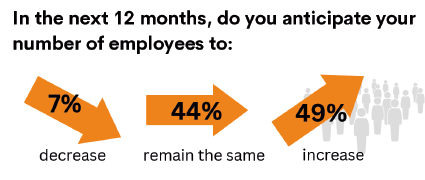
- Employers anticipate growth. Nearly half expect to increase their workforce over the next 12 months, while 44% expect staffing levels to remain steady.
- Most employers expect hourly wages to increase this year. Twenty-eight percent say wages could increase by up to 3% while 55% expect between 3.1-4% and 6% anticipate more than a 4% increase.
- Rising costs continue to pressure businesses as 73% report increased supply costs. Federal policy and tariffs or trade wars are identified as leading inflation concerns.
- Workforce barriers extend beyond hiring. Sixty-six percent report childcare affordability challenges, while 54% identify housing as a workforce barrier. A quarter of businesses report using legal immigration to fill workforce needs.
- Regulatory uncertainty is growing. Thirty-eight percent identify regulatory uncertainty and changing requirements as their leading regulatory concern. Local regulations are increasingly cited as an impediment to business operations.
- Artificial intelligence adoption continues to expand, with 42% frequently using AI, compared to 15% in 2024. Employers largely view technology as a tool to improve productivity.
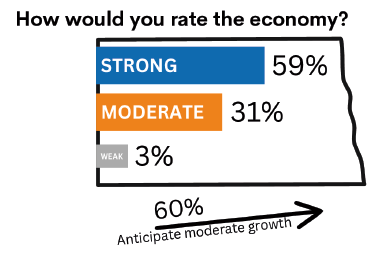
- In rating North Dakota's economy, 59% indicated it is strong and 31% indicated it is moderate, while 60% anticipate moderate growth. In comparison, 17% rated the national economy as strong and 64% rated it moderate, with 45% anticipating the economy to remain flat.
Although respondents generally view North Dakota’s business climate favorably, they also identified opportunities for state government to support continued economic growth.
Workforce attraction and retention solutions, healthcare affordability, and infrastructure investments ranked as the top three priorities for state action.
The findings also reinforce the importance of maintaining policies that contribute to North Dakota’s competitiveness, including competitive tax policies, stable workers’ compensation and unemployment insurance systems, and economic development incentives.
“These results are particularly valuable as we look toward the 2027 legislative session,” Spencer said. “Businesses are telling us where the challenges exist, but we also need to recognize the policies that are working. Protecting that foundation while addressing emerging barriers is how North Dakota remains a place where businesses want to invest, operate, and grow.”