
Shipping issues disrupt ND exports
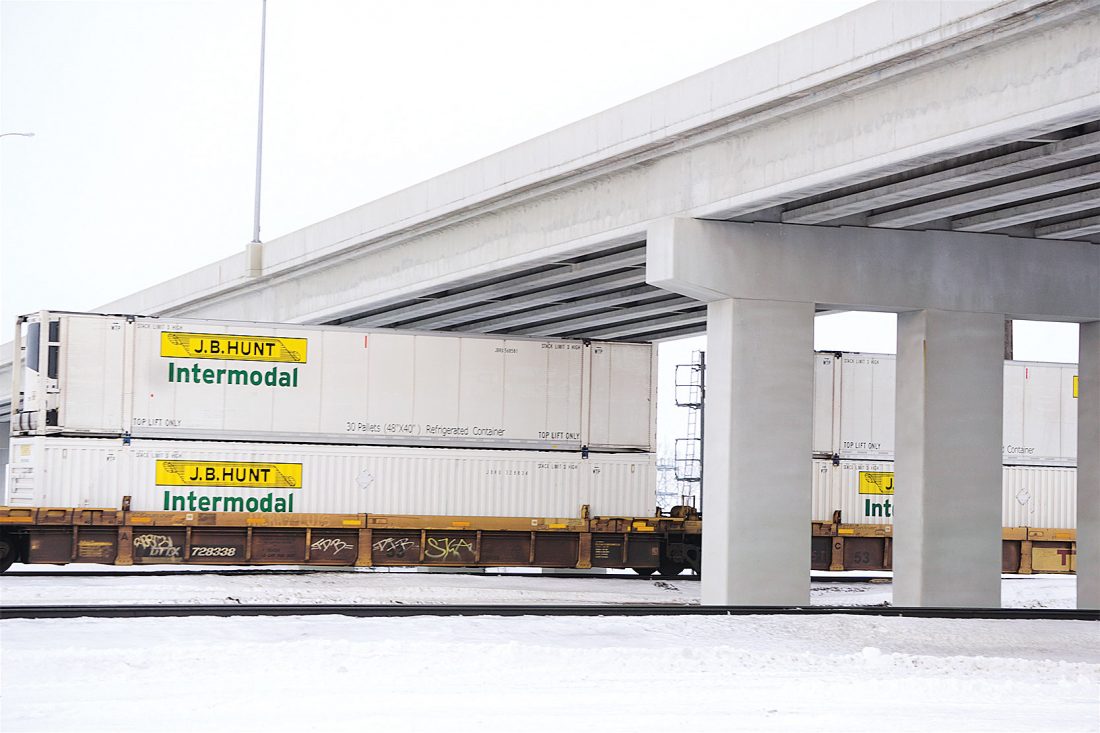
Jill Schramm/MDN A BNSF train carrying intermodal containers passes under the 55th Street bridge in east Minot in January.
A shortage of shipping containers is causing severe disruption to exports from North Dakota and northwest Minnesota, according to the North Dakota District Export Council.
“Not only are we not able to fulfill sales due to the container shortage, we are in grave danger of losing customers we have developed over many years,” DEC Chairman Jay Schuler said in a release following a recent meeting of council members. “These are all customers that bring added value to Minnesota and North Dakota.”
Richland IFC in Wahpeton is experiencing its worst year ever financially, said Rick Brandenburger, president, in a statement provided through the council. The crux of the problem is loaded containers from Asia are unloaded in the United States and shipped back to Asia empty by foreign-owned shipping lines, he said.
“All the while our warehouses are full, awaiting containers to fill. We have been longstanding customers for over 30 years with these shipping lines. They are driving the business away from the U.S,” he said. “They may drive us out of business. We need our legislators to fix this injustice.”
The intermodal port in Minot has empty containers, in part due to a slowdown in winter shipping, said John MacMartin, president of the Minot Area Chamber EDC. Much of the port’s activity is in farm commodities, and between last year’s drought and extreme cold this winter, fewer agricultural products are moving currently.
The Minot port also accesses containers routed through Chicago, which has been able to supply empty containers to meet demand, MacMartin said. He attributed the problems of many North Dakota exporters to decisions shipping lines are making to increase their bottom lines at the expense of exporters. Those decisions are driven by the enormous returns they now receive in moving product from China. It is more profitable to return an empty container to China for refilling than to wait on a U.S. customer to fill a container to ship to Asia, he said.
MacMartin said the Minot port may be an option for some exporters.
“It’s just going to take a while for us to get the word out about what is going on in Minot and get them to consider trucking things this way and putting them in containers or having a container taken to them,” he said.
However, he added, shipping to the West Coast through the Minot port isn’t for everyone. Depending on the rail line being used, destination point and various cost factors, Minot may not be the solution. For instance, products that traditionally ship to the East Coast for transport to Europe may not be economical to ship via the West Coast.
Todd Sinner, partner with SB&B in Casselton, said in a written statement that shipping issues continue despite countless efforts to get the Federal Maritime Commission, Congress and White House to penalize ocean carriers for direct violations of the international Shipping Act.
“Without immediate action, the domino effect will be that businesses will fail, producers will realize less income and our rural economies will suffer. Food manufacturers of U.S.-grown food ingredients are fed up. They are now pursuing options to produce their food in other parts of the world due to the broken and unreliable transportation system,” Sinner said.
Olga Hall, director of international sales with RDO Equipment in Fargo, also said in a statement through the council that she has never seen in her 23 years in the industry as many supply chain issues as currently exist.
“Tractor production is 8-11 months delayed. Farmers are not trading equipment as much because of delays in new orders, and this limits business,” she said. “We can’t find truckers, especially for long distance hauling. On the container issue, it is difficult to make shipping commitments because there are so many delays and factors that are out of our control. It’s making the whole operation inefficient.”
“We find our international partners asking for air cargo versus ocean cargo due to the delays in shipping and highly elevated costs,” said James Hamel, interim CEO for Swanson, Fargo, in a statement. “Air freight is still more costly so both options result in a less available working capital for our international partners to purchase Swanson products and with more working funds going towards shipping costs/freight. We are working hard on managing the issue in the short term and hopeful that our government and freight industry can find a timely and reasonable solution in 2022.”
Business
Financial agency earns client service award
Legacy Financial Partners, a private wealth advisory practice of Ameriprise Financial Services, LLC, has earned ...

Dakota Square Mall names new general manager
Lignite council selects VP of research, development
The Lignite Energy Council has named Jason Laumb as vice president of research and development. Laumb will join ...
Outdoor living, home design company renames business
Outdoor Comfort Solutions of Minot, which provides outdoor living spaces and home renovation services in North ...
FirstLight Home Care earns recognition
FirstLight Home Care of Central North Dakota has been recognized by Activated Insights as a Provider of Choice in ...
Eagle Awards announced
The Minot Area Chamber EDC announces the Eagle Award winners for February.These individuals were nominated by ...