
New state carved out of Civil War
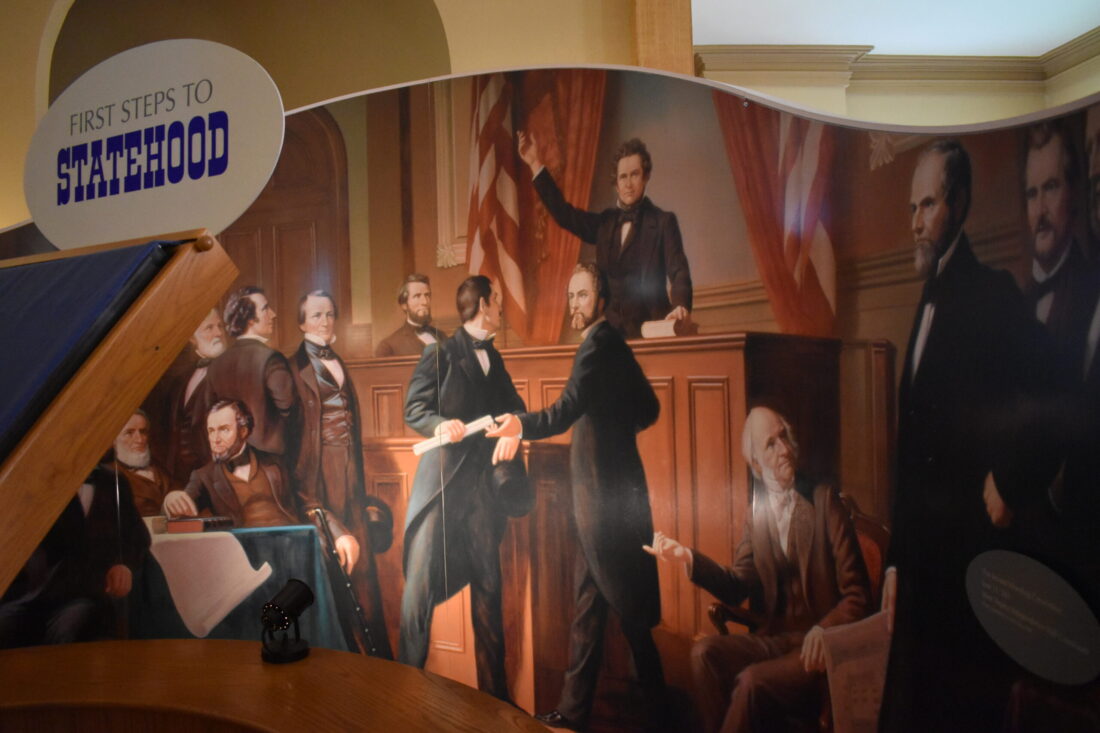
Submitted Photo This display at West Virginia Independence Hall in Wheeling depicts historic action taken in the third floor courtroom of the building back in 1861. The Wheeling Conventions led to West Virginia separating from Virginia during the Civil War and becoming the 35th state in the nation. Photo by Eric Ayres.
Submitted Photo This display at West Virginia Independence Hall in Wheeling depicts historic action taken in the third floor courtroom of the building back in 1861. The Wheeling Conventions led to West Virginia separating from Virginia during the Civil War and becoming the 35th state in the nation. Photo by Eric Ayres.
Trending
The story of America tells of only one state carved out of another during the Civil War - West Virginia - and in the mid-1800s, the flourishing riverside city of Wheeling found itself at the epicenter of that pivotal moment in U.S. history.
A thriving economic base had been taking root in the pre-Civil War period of Wheeling, Virginia. Wheeling in the early 1860s was the second-largest city in Virginia, trailing only Richmond.
"Wheeling was kind of emerging as a distinctly different type of city and place in Virginia," said Hal Gorby, historian and professor in the Department of History at West Virginia University. "In western Virginia for the last decade before the start of the Civil War, there had been a lot of tensions around issues of taxation, economic development, lack of funding for infrastructure and for public education -- a lot of these sort of under-developments that had been brewing since Virginia emerged as a state. This had been building up for a while."
A manufacturing base had developed and was thriving in Wheeling around iron, nails, glass and other industries.
"There was slavery in the Wheeling area, but it was not the same economic driver as it was in eastern Virginia and in some parts of what is now West Virginia as well," Gorby said. "This was the area that was becoming more industrialized, even in the decade and a half before the Civil War. It was much more connected to Ohio and Pennsylvania than it was to eastern Virginia."
With tensions boiling over different views on the moral and economic impacts of slavery, Civil War erupted in April 1861. Shortly after war began, Virginia seceded from the Union - action that did not sit well with many in the western and northern portions of the state at that time.
"The Intelligencer (the oldest daily newspaper in West Virginia) played an historic role in this, as well," Gorby noted. "When The Intelligencer fell under the editorship of Archibald Campbell, it became a much more pro-union, anti-slavery, pro-abolitionist newspaper that was really talking about the issues that western Virginians were feeling politically, economically and even somewhat culturally."
At that time, daily newspaper coverage in what is now western Virginia was not common. Most newspapers only published weekly news. The Intelligencer, established in 1852, took advantage of advanced printing technology under Campbell’s leadership. The newspaper changed its name to the Daily Intelligencer from 1859 to 1865 to boast its ability to provide fresh news on a daily basis.
"When he took over editorial control around 1855 or so, he also helped the paper develop an identity," Gorby explained. "In its first few years, it didn’t have any sort of strong position in terms of national news it was reporting or the editorial (voice). But Archibald Campbell made it more in line with the Republican party that was budding at that time and obviously stressing a pro-union, anti-slavery position.
"It was one of the newspapers that campaigned vigorously for Abraham Lincoln, along with the Wellsburg Herald in that part of the state. That obviously played a major role in developing a political consciousness - people had been upset about problems in Virginia prior to the Civil War, but I think (the newspapers) played a key role in helping people organize their thoughts about what issues were at play."
Following Virginia's secession, delegates from the northwestern counties that opposed the action gathered in Wheeling to establish a Restored Government of Virginia that remained loyal to the union. The third floor district federal courtroom for the Western District of Virginia in the Custom House - now known as West Virginia Independence Hall - became the site of the Wheeling Conventions in 1861 ... and ultimately the birthplace of a new state.
Campbell's urging to Lincoln to allow the formation of West Virginia played a key role. West Virginia officially became the 35th state in the union on June 20, 1863, as war raged on.
Wheeling’s economic structure, largely anti-slavery sentiment and pro-union views made it a centralized hub where like-minded leaders could organize before and during the Civil War. Its location also separated it from the front lines of war and kept it less susceptible from Confederate attack.
From 1861 to 1863, Wheeling served as the capital of the Restored Government of Virginia. When West Virginia became a state, Wheeling became its first capital.
"When the Union movement was growing, economically Wheeling made a lot of sense," Gorby said of the city’s prominent role in the new state government. "It was one of the few places west of the mountains that had any sort of financial or banking capital, so there were a lot of investments from the Wheeling area into developing other towns in the region."
Towns in the new state were connected by the network of roads, rails and waterways that centered in Wheeling.
"Wheeling was really caught up in this first-generation of West Virginia’s existence," Gorby said, noting that historians view this period as the state’s "floating capital" era. There was a transition in power taking place in statehood government in the early 1870s, as ex-Confederates were permitted to vote. A pull to bring governmental power to the central part of the state ensued.
In 1870, the state capital was temporarily moved from Wheeling to Charleston, which was still developing in terms of infrastructure, Gorby said. But there was still no well-established railroad system or capital structure in Charleston.
"So in 1875, the state capital moved back to Wheeling," he said.
That push and pull continued for a few years until Charleston began to establish an infrastructure and economic environment that could support a home to state government.
"It moved back to Charleston in 1885," Gorby said. "By that time the civic boosters in Charleston and the Kanawha Valley had worked to bring about a more respectable Victorian capitol complex."
Charleston has remained the state capital. Yet the beginning history of the state and an important chapter in America’s history remains firmly seated in Wheeling.
The birthplace of West Virginia and the original Gateway to the West continued to grow well into the early 20th century, becoming a booming industrial hub along the nation’s busiest trade routes. Congress designated Wheeling as a National Heritage Area because of its pivotal role in westward expansion, its industrial legacy and its unique role in American history.