
Japan outreach coordinator teaches Minot Japanese culture
Trending
Serving as a cultural ambassador has been a friend-making experience, according to Shunsuke Aoki of Japan, who is coming to the conclusion of a two-year stay in North Dakota.
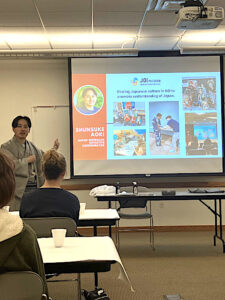
The Minot Public Library recently hosted two cultural events conducted by Aoki. One was a class on Japanese calligraphy and the other an interactive lecture about Japanese pop culture. Those events coincided with the library's "Japan Week," a week of activities celebrating Japan and Japanese culture, organized by Minot librarian Pam Carswell.
"There are so many aspects to Japanese culture. There's something for everyone to get interested in - nature, history, culture, food, customs, anime, music," Aoki said.
Aoki, 27, is a coordinator for the Japan Outreach Initiative (JOI) program. According to the program initiative, the purpose is to bring volunteer Japanese coordinators to regions of the U.S. where Japanese culture has been less accessible.
Volunteers stay in their assigned U.S. city for two years and engage with their American community on a daily basis. Volunteers also travel across their state to educate others about Japanese culture. This education includes hosting lectures, doing hands-on activities with youth and performing events focused on traditional Japanese art forms. There are 18 Japan Initiative coordinators currently in the U.S.
Aoki has been stationed in Dickinson and lived on campus at Dickinson State University in an apartment.
"I was surprised the airport in Dickinson was really tiny. It felt like a station," Aoki said of his first impression of North Dakota. Aoki said he had no idea what North Dakota would be like because he had only previously ever been to Las Vegas in the U.S. which was vastly different.
Aoki said North Dakota is very flat in comparison to his home city in Japan. Aoki is from Sapporo, which is in the Hokkaido prefecture of Japan. Sapporo is the fifth largest city in Japan and Hokkaido prefecture is the largest of Japan's 48 prefectures.
"Prefectures are like U.S. states in a way," Aoki said. Hokkaido is in the northern region of Japan.
"It snows a lot. There's mountains, waterfalls, rivers, a lot of nature. It actually snows a lot more in Hokkaido than here but North Dakota is a lot colder," Aoki said.
Aoki said he suspected the JOI program sent him to North Dakota because they knew he could already tolerate a snowy climate, but this was never confirmed.
Aoki's journey to becoming a Japan outreach coordinator started when he was a university student. As an undergrad, Aoki participated in an international program in which he traveled to Bhutan in South Asia. During that trip he became interested in cultural exchange and international education. Aoki also traveled to the 47 other prefectures in Japan to make a promotional video about his country.
"I wanted to showcase the charms and attractions of Japan," he said.
Aoki then studied abroad in Australia for three months before attending graduate school in Tokyo to pursue his master's degree. Aoki enrolled in the Japanese Language Teacher Program and became licensed in teaching the Japanese language.
"After I finished my language program, I found the poster for this (the JOI) program, and I wanted to do it," Aoki said.
One of the things Aoki noticed right away when he arrived in North Dakota was how large everything was - aside from the Dickinson airport.
"I feel like everything is bigger compared to Japan, such as Walmart, cars and food portions," Aoki said.
Aoki also said he noticed American personalities, in his opinion, were more friendly and open-minded compared to Japanese people.
"People would come up and talk to me or make small talk. Even people I don't know would smile or say ‘hi’ when they would see me. That isn't very common in Japan," Aoki said.
Aoki said many Japanese people prefer smaller groups and communities, whereas Americans would, he said, "invite a lot of friends to a party." Aoki said during his daily life in North Dakota, most people have been very welcoming.
"I never faced any rudeness or discrimination from Americans," Aoki said.
Another thing Aoki noticed was the lack of public transportation in North Dakota.
"I was in Tokyo for six years while I was an undergrad and grad student before I came over to the U.S., so I was kind of shocked Dickinson didn't really have buses or trains or any public transportation," he said.
In Japan there is a complex yet easy to understand network of subways, trams, trains and high speed trains, also known as shinkansen or "bullet trains," making up Japan's public transportation system.
Aoki said he ended up buying a car to use during his stay in North Dakota.
"My first month in North Dakota I didn't have a car. It took about two months for me to buy a car because my budget was limited," he said.
However, one thing Aoki noticed North Dakota had in abundance was clear views and stars in the night sky.
"I love the view of the North Dakota night sky with all the stars. That's hard to see from Tokyo and Sapporo. I saw the Northern Lights while I was here too and that was my first experience seeing them," Aoki said.
Another first for Aoki in the U.S. was riding a horse. Aoki went to visit friends who live on a ranch in Fargo.
"They let me ride a horse and it was really fun," Aoki said, although he also said he was a little nervous at first because of how big horses are.
"My friends also showed me the work they did on the ranch. One day they had to round up the cattle and they used a four-wheel ATV to do so. I got to be a passenger and watch and it was really cool," Aoki said.
Aoki said he made many friends during his stay.
"Of course I missed my family, my hometown, and my friends back home sometimes. But I made friends here. I joined a judo club in Dickinson (Roughrider Judo Club) and those friends invited me camping, rock climbing and shooting," he said.
In addition to making friends, Aoki has educated more than 3,500 people on Japanese culture during these past two years.
"I need to report to the JOI organization how many people I've taught, so I do track how many people attend my events," Aoki said.
Aoki even brought seven of his students with him to visit Japan this past May.
"Five of them had never been to another country so I think it was a really good experience for them. Traveling abroad is a good opportunity to get new perspectives on different ways of thinking. It's really important to step outside of your comfort zone and step into your challenge zone so you can grow as a person," he said.
Aoki said his favorite thing about North Dakota would have to be the people.
"Everyone is very kind, friendly, and welcoming. I felt welcome and safe here," he said.
Aoki will be concluding his service in the JOI program this summer and will be returning home to Japan on July 24. A new Japan outreach coordinator will take his place in North Dakota and will be stationed at the Plains Art Museum in Fargo. Like Aoki, the new coordinator will be staying in the community for two years and will travel across the state, educating and making meaningful connections.
"I just want to say thank you so much for welcoming me. Thank you to the people who supported me, like the friends I made and the people who invited me to do events. I will miss North Dakota," Aoki said.