Xcel customers object to proposed rate hike
PSC hears concerns about green energy costs
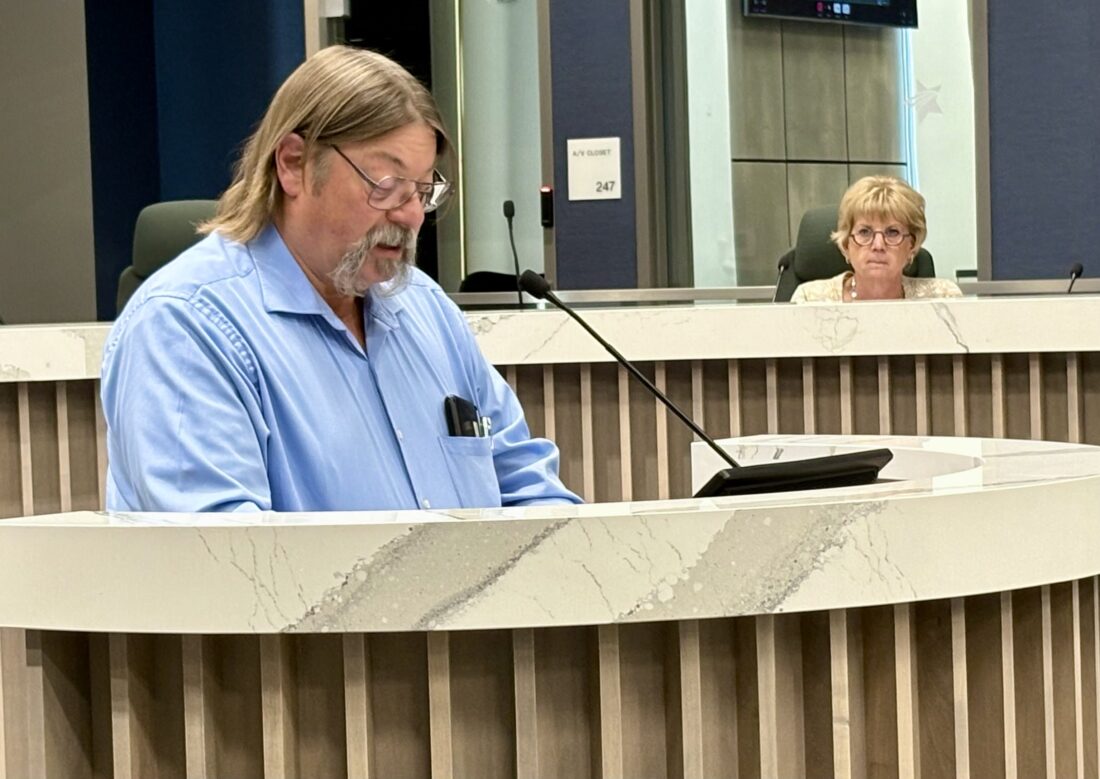
Jill Schramm/MDN Bob Hayes of Minot reads comments into the record at a statewide North Dakota Public Service Commission hearing on a proposed Xcel Energy electrical rate increase at Minot City Hall Monday, Oct. 13. At right is Public Service Commissioner Sheri Haugen-Hoffart, who participated from the Minot meeting site.
Consumers questioned the role Minnesota’s green energy policies should play in setting costs for Xcel Energy’s North Dakota electrical customers at statewide Public Service Commission rate hearings Monday, Oct. 13.
Xcel filed for a $44.56 million rate adjustment last December, which amounts to a 19.34% increase or $22.34 a month for the average, non-heat residential customer using 774 kilowatt hours. The PSC held online meetings with live locations in Minot, Bismarck, Fargo and Grand Forks to take public input.
Bob Hayes, Minot, took issue with Xcel’s plan to use wind, solar, hydropower and nuclear energy to replace its coal-burning facilities in North Dakota, Minnesota and Colorado.
“Xcel last year retired one of three coal units at the Sherburne County Generating Plant, referred to as Sherco, near Monticello, Minnesota. It plans to retire Sherco’s remaining coal-fired units in 2026 and 2030, marking the company’s full exit from coal. The plan is to construct a solar collection plant and have North Dakota customers pay almost twice as much as Minnesota customers for the conversion. The customers in Minnesota have been earmarked to pay about 10% of the cost for the conversion,” he said. “North Dakota has been chosen to pay 19% of the conversion, while not obtaining any benefits from the present coal plant or the proposed solar plant.”
Hayes cited benefits to using North Dakota lignite.
“When pulverized, it burns efficiently and cleanly. In the coal gasification process, there’s very little effect on the environment, with the exception of producing carbon dioxide and steam. North Dakota facilities are self-sufficient and produce affordable energy,” Hayes said. “Minnesota appears to be deconstructing North Dakota infrastructure by eliminating coal-burning facilities.”
Josh Askvig, state director for AARP, Bismarck, said his organization also doesn’t want costs associated with Minnesota’s energy policies to affect North Dakota ratepayers.
“We have no standing on what policy may be right or wrong, but North Dakota ratepayers shouldn’t be paying for policy decisions made by another state,” Askvig said.
Askvig objected further to the size of the 19.34% rate increase, which includes a hike in the customer fixed charge from $15 a month to $21.50 a month.
“That would be among the highest in the country – not a good proposal and something we would not support,” he said. “High fixed charges make it more difficult for consumers, specifically residential ratepayers, to control their energy bill.”
Askvig added the national average for company rate of return is about 9.6%, and Xcel appears to be asking 10.3%.
“We think it should be more in line with the national average,” he said.
Deven Mantz, Minot, said consumers are grappling with rising costs while investor-owned Xcel reported about $1.9 billion in profit last year.
“It’s not a matter of survival for a struggling public utility. This is a brazen attempt to further enhance shareholder value on the backs of working people. We are not responsible for underwriting massive corporate profits. We have no obligation to finance Xcel’s infrastructure projects, like their nuclear plant updates in other states or the closure of coal plants,” Mantz said.
“This is the core difference between a corporation driven by profit and a utility dedicated to its community,” he added. He asked PSC to force Xcel to transition to a customer-owned cooperative due to its monopoly status.
Joan Hawbaker, Minot, thanked Xcel for its quick response to service outages but also said the increase is too much.
“For those people that are living basically paycheck to paycheck or Social Security check to Social Security check, that doesn’t work for them,” she said. “So, increase, yes, as needed, but only as needed, and I don’t think 19% is needed.”
Brent DeKrey, associate director of facilities at North Dakota State University, Fargo, said higher electrical costs will drive up student tuition and reduce NDSU’s resources available for research and technology.
“Rising rates increase our operational costs, which impacts students and taxpayers of North Dakota,” DeKrey said. “At the proposed rate increase, NDSU projects that our annual electrical cost will rise over $1 million.”
Since February, Xcel customers have been paying an interim rate increase of $27.37 million or 11.8%, amounting to $11.30 more for the average residential customer. The interim increase would be incorporated into any rate increase approved by the PSC, and if the PSC-approved rate is lower than the interim rate, consumers would get rebates.
From 2019-2023, residential customer bills were about 28% below the national average, according to Xcel. Even with the proposed rate increase, residential bills should remain well below the national average because of offsets from fuel cost savings, said Alex Nisbet, regulatory policy specialist for Xcel in North Dakota.
Xcel also began in August to refund a production tax credit associated with the nuclear generation in Xcel’s system. Xcel plans to refund $12.5 million to North Dakota ratepayers over the course of a year.
Nisbet said even with the $44.56 million rate request, Xcel’s bills would be below cost increases reflected in the Consumer Price index over the last decade.
A Grand Forks consumer asked for a comparison of rates paid by Xcel’s Minnesota customers versus its North Dakota customers. He also submitted questions about the reasons behind the closure of the Sherburne plant, the cost differences among different renewable and fossil fuels for generation and any potential move to replace natural gas with renewables.
While answers to most questions weren’t available at the hearing, Nisbet responded regarding natural gas generation, saying Xcel recently approved a new natural gas combustion turbine in Minnesota, and additional facilities are proposed. A plant is planned in connection with a natural gas pipeline expected to be built from the Bakken in western North Dakota to Fargo by the end of 2030.
Nisbet said investments made by Xcel are largely behind the need for a rate increase.
“We’ve spent $460 million in just North Dakota capital investments since our last rate case four years ago,” he said. Overall investments have included improvements to system monitoring infrastructure and to the two nuclear plants in Minnesota. There’s been investments in equipment and vehicles and in a new service center in Grand Forks.
Nisbet said Xcel is not serving or proposing to serve any large-load data centers.
“I would just point out, systemwide and as a company, we want to make sure that any investments in data centers, or any data centers that are potentially looking at coming onto our system as load, that they’re covering their incremental costs, and there’s no cost subsidization by existing customers,” he said.
The PSC will hold a technical hearing on the rate increase Dec. 1-5. Because the PSC will need additional time to review the information, Xcel doesn’t expect a permanent rate change until next spring.
Xcel has about 97,000 electrical customers in North Dakota, including residents of Minot, Burlington, Des Lacs, Berthold and the Ward County townships of Sundre, Kirkelie, Nedrose and Harrison.
Local News
ND company sentenced on Clean Air Act violations
BISMARCK – U.S. Attorney Nicholas Chase announced Friday, Dec. 5, a North Dakota company has been sentenced for ...
Governor sets tentative date for special session
BISMARCK — Gov. Kelly Armstrong informed legislative leaders on Friday, Dec. 5, that he has identified Jan. 21 as ...
PSC sets public hearing for energy project
BOWBELLS – The North Dakota Public Service Commission will hold a public hearing on Friday, Dec. 19, regarding a ...
Library drops Hoopla digital platform
Minot Public LIbrary has announced that starting Jan. 1, it will no longer be offering Hoopla, a digital media ...

Public input sought in health unit survey