Emerald ash borer has arrived in North Dakota
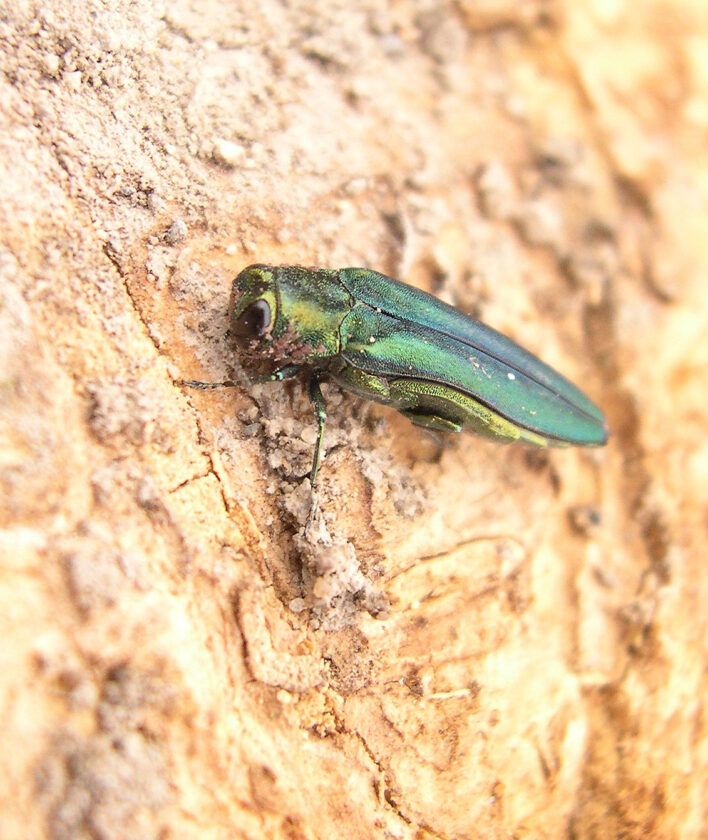
The adult emerald ash borer is 1 cm. (0.394 inch) long and bullet-shaped with metallic emerald green wing coverings. Photo from N.D. Department of Agriculture.
Emerald ash borer (EAB) has made its way to our state. In late August, adult EAB were collected from a trap placed in LaMoure County near Edgeley.
The North Dakota Department of Agriculture (NDDA) and our partners have been preparing for emerald ash borer’s eventual arrival for many years. Each summer, we’ve been placing and monitoring traps and promoting awareness through outreach events, training and communication with the public.
EAB is a wood boring insect originally from Asia, first found in the U.S. in 2002. It has since spread to 37 states and killed hundreds of millions of ash trees.
North Dakota has more than 90 million ash trees that are at risk. Ash trees make up nearly 70% of all tree canopy in North Dakota, a quarter of the windbreaks, and more than 40% of trees in communities. Unless treated, infested ash trees will die within a few years.
EAB cannot travel far on their own but hitch rides on firewood. Firewood is often cut from dead and dying trees that may be carrying insects and diseases. Moving this firewood can spread these pests. NDDA maintains a quarantine restricting movement of regulated commodities from infested areas. That means you cannot move firewood, ash nursery stock, ash logs and other plant parts from areas with EAB into areas not known to have EAB. The quarantine applies to LaMoure County as well as specified areas in the other 36 states that currently have EAB. A list of quarantined or infested areas is available from NDDA. Leave firewood at home and purchase or gather it from local sources. Moving regulated materials from a quarantined to a non-quarantined area can result in civil penalties of up to $5,000.
NDDA is collaborating with the North Dakota Forest Service and North Dakota State University Extension to determine the extent of the infestation in LaMoure County and will continue monitoring ash trees and conduct outreach in the coming months.
Besides buying and gathering firewood where you plan to burn it, residents should check their ash trees for signs of infestation, which include dieback; S-shaped tunnels, also known as serpentine galleries, under the bark; small D-shaped exit holes and woodpecker activity in the upper canopy of the trees. It is very unlikely that you will see an adult insect as they are very small and have a short flight period. If you think your ash tree may be infested, please contact NDDA.
One option to protect high-value trees are insecticide treatments. Treatments are not recommended until EAB is detected within 15 miles. Residents who choose to treat their ash trees are strongly urged to select a reputable tree service company with a certified applicator able to do these treatments. Many treatment options are restricted use and can only be done by a tree care professional.
It is also very important to diversify tree plantings. Green ash is the most plentiful tree in the state but as these trees are removed, they should be replaced by many different species rather than another single species. NDSU’s North Dakota Tree Selector or your local nursery can provide options.
With your help, we can slow the spread of EAB.
Local News

Wind project hearing raises road concerns
Research Center precipitation
On Friday, May 22, at 8 a.m., 0.07-inch of moisture was recorded at the North Central Research Extension Center, ...
Interior to return $28M to Native families
The Department of the Interior on Friday, May 22, announced that $28 million has been distributed to tribal ...
Open houses set for Compatible Use Study
The City of Minot is updating the 2015 Minot Air Force Base Joint Land Use Study with a Compatible Use Study ...

Faith in action: Cru delivers water filters in Mexico