Humanities ND brings lifelong learning, stirs conversation
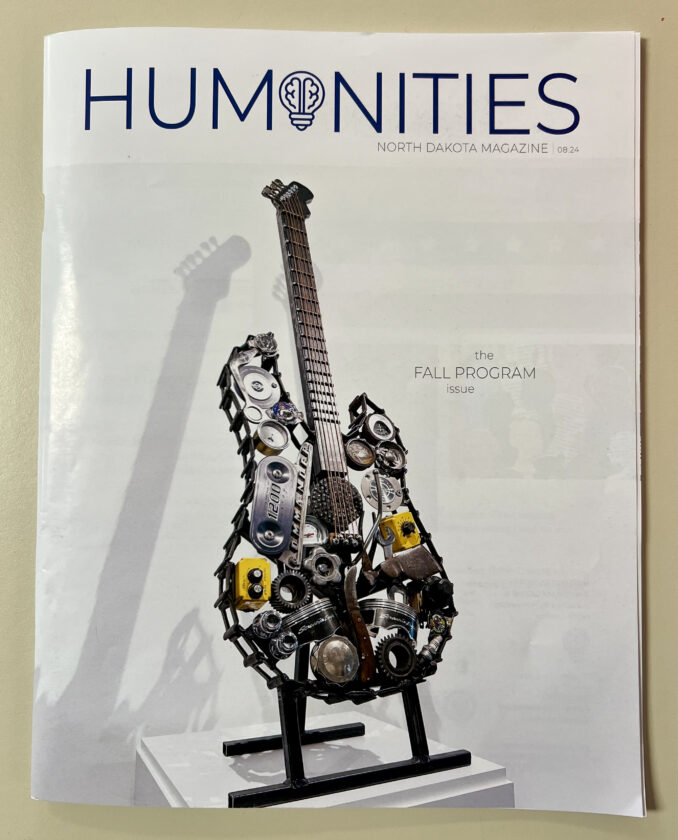
Jill Schramm/MDN The fall issue of Humanities North Dakota’s magazine features essays, profiles and information on programming. The logo in its name reflects its mission to shed light on issues so people can start conversations.
Many North Dakotans aren’t aware of Humanities North Dakota, and if they are, they might not know what it does or even how to define humanities. Barb Solberg of Minot, chair of Humanities ND, wants to change that.
“My personal goal as a board member is to make my part of the state, northwest North Dakota, know that they, too, have access to these incredible speakers, to these incredible ideas, to continue their lifelong learning, and they can do it in their own living room,” said Solberg, who has served on the board since 2019.
Another goal is to get enough members in the Minot area to be able to host in-person events, she said.
“We have 110 members in Minot now,” Solberg said. “I find that to be pretty impressive.”
A donation of $10 or more is all it takes to gain membership in Humanities ND and obtain free access to a variety of online and in-person programming. Resources often are available to nonmembers at a nominal cost and, in some cases, also are free.
A Humanities ND event in Fargo will be livestreamed to First Lutheran Church in Minot on Thursday, Oct. 10, from 7-9 p.m. “No Cure for Being Human” will feature Dr. Kate Bowler, a professor of American religious history at Duke University in Durham, North Carolina. After her diagnosis with Stage IV cancer at age 35, Bowler wrote her memoir “Everything Happens for a Reason (and Other Lies I’ve Loved)” and “No Cure for Being Human (and Other Truths I Need to Hear).”
The event is offered by Humanities ND through the Marilyn Hudson Brave Conversations Project. Hudson was a member of the Three Affiliated Tribes and a tribal historian.
Humanities ND previously livestreamed a presenter three years ago at Minot State University, Solberg said.
“But our goal, really our audience, the population we want to serve, are out-of-school adults who want to still keep learning,” Solberg said. “They can do it in this way. You can do it by yourself, or you could do it with friends. There are small town libraries that would benefit if they wanted to have some programming.”
Humanities ND’s online vault includes podcasts and speaker presentations, including GameChanger, a series of webinars in which inspired thinkers share big ideas. There is a seven-month writing program to guide authors on their book projects, although space is limited and there is a charge. The vault contains recorded live events that people can watch, which will include the Bowler event.
Programming available online includes Chautauqua Chat, featuring performances by scholars impersonating historical figures. It includes OneBook, One North Dakota, an online book club. It includes Public University, which consists of one to 12 session humanities courses taught online by scholars, without tests or grades. Among fall courses are those on Native American languages and culture as well as “Write Where You Are,” “Understanding Science Fiction” and “Understanding Israel and Gaza.”
“There’s something for everybody,” Solberg said. “When you go to a national convention, they are always blown away by what North Dakota has out there for people.”
As a small nonprofit, the ability to get the word out within the state is limited, said Brenna Gerhardt, executive director for Humanities ND. Still, the organization has built a core group of dedicated members and a total membership statewide of about 500, she said.
Both Gerhardt and Solberg said rural locations and community size shouldn’t matter when it comes to accessing lifelong learning. Gerhardt said the gravitation to online offerings has been an asset in that regard.
“Our membership and active participation really boomed because we could contract with scholars all over the nation, and people in rural communities had access any night of the week to a number of opportunities in lifelong learning that didn’t exist before. So, now our challenge is we have all this great online content, and people have asked us not to take that away because they really enjoy it. But how do we now balance that with bringing back in-person with a small staff?” she said.
When Humanities ND began, programming was only in-person and in population centers such as Bismarck and Fargo.
When the COVID-19 pandemic happened, Humanities ND had to rethink how it was offering programming because in-person events weren’t going to work as they once did. That led to the creation of the online vault.
Humanities ND started in 1973, funded through the National Endowment for the Humanities, an independent federal agency. The endowment, created by Congress in 1965, is the nation’s largest public funder of the humanities, which include history, philosophy, literature, language, ethics, law, archaeology, political theory, comparative religion, anthropology, sociology and media and cultural studies. State humanities organizations began forming in 1971 and now exist in every state and U.S. jurisdictional territory.
Humanities ND receives the bulk of its budget of about $800,000 from the national endowment, funded by Congress, according to Solberg and Gerhardt. The remainder comes from grants and donations.
Operated by a small staff and board of 12-15 people of diverse backgrounds from across the state, the organization produces a magazine with essays, profiles and information on the latest online offerings.
Solberg said Humanities ND is not political and does not take positions on issues. Its job is to hold the middle and give people information so they can have conversations about the issues, she said. Part of Humanities ND’s role is to help facilitate conversations.
“One of the things we always say is we shed light on topics, not heat. We are just shedding a light on these things so that you can continue learning. And when I think about the humanities, I always think that’s the track upon which we are who we are. Because humanities is the same as humanity. It’s people. It’s what makes us who we are. What is our connection to our past, to our future, to other cultures, to languages, to law, to literature? All of those things are part of what the humanities happen to be,” Solberg said. “It’s what makes our lives rich.”
Local News
ND company sentenced on Clean Air Act violations
BISMARCK – U.S. Attorney Nicholas Chase announced Friday, Dec. 5, a North Dakota company has been sentenced for ...
Governor sets tentative date for special session
BISMARCK — Gov. Kelly Armstrong informed legislative leaders on Friday, Dec. 5, that he has identified Jan. 21 as ...
PSC sets public hearing for energy project
BOWBELLS – The North Dakota Public Service Commission will hold a public hearing on Friday, Dec. 19, regarding a ...
Library drops Hoopla digital platform
Minot Public LIbrary has announced that starting Jan. 1, it will no longer be offering Hoopla, a digital media ...
Public input sought in health unit survey